
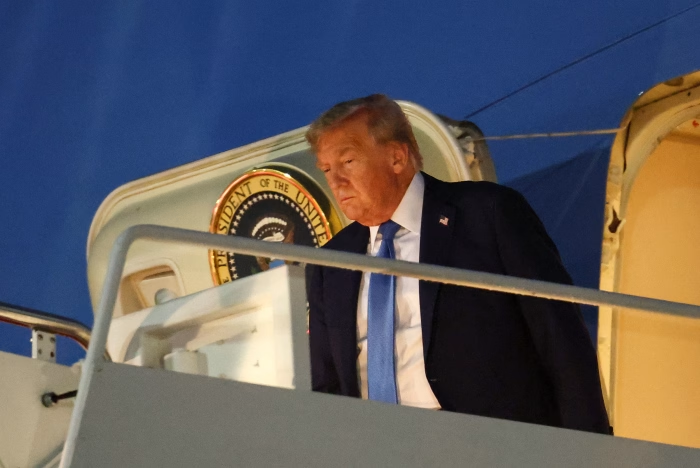
He’s sending many signals, but needed is a strong stand against nuclear proliferation.
In keeping with Trumpian practice, Donald Trump never produced a cogent strategy to end the Ukraine war. In keeping with Trumpian practice, his voters also don’t care as long as there’s no blowback.
Events are pointing to another dubious outcome, the Iranian regime surviving with some part of its nuclear program intact, which is tantamount to the regime itself surviving.
That regime ought to be teetering: No air defenses, no striking power, denuded of its proxies Hamas and Hezbollah, penetrated by Israeli agents, its ballistic-missile capacity reduced by drones operated from inside Iran, its leadership cadres targeted and eliminated in the first minutes of the war. There are even reports of senior Iranian officials fleeing to Russia.
Israel has been non-Trumpian in its consistency, laying the groundwork, we learn, for its drone strikes inside Iran as far back as 2007. Delivered to the flighty Mr. Trump now is an opportunity and a choice. So far, we hear talk of “deals, deals, deals” in terms that logically imply the mullahs and some remnant of their nuclear ambitions emerging not entirely in tatters.
Yes, the risk of wider instability exists, but the alternative opportunity is a global strategic one. Clinton and George W. Bush veterans rightly kick themselves for failing to stanch North Korea’s nuclear program. If, 73 years ago, Truman and Eisenhower had known Pyongyang would now be threatening American cities with ICBMs, they might have thought differently despite the immediate incentive for an armistice.
The opportunity today is to snap a strain of nuclear proliferation that might soon run out of control, insurance for regimes whose dangerous enemy is their own people.
Any Trump boldness, though, would need a degree of U.S. elite buy-in. Its lack may be the hidden factor that diverts Mr. Trump to a lesser path.
In early 2017, it seemed worthy of eye-rolling when the U.S. intelligence community decided to punish Americans for how they voted. Now it seems something else amid the high geopolitical stakes of a second Trump term. The current Israeli prime minister, Bibi Netanyahu, has no fiercer critic than former Prime Minister Naftali Bennett, yet Mr. Bennett says Israelis are united on the Iran war. Would any crisis or opportunity be sufficient for Democrats and their bureaucratic and media allies to put aside the fight against Mr. Trump?
The national-security reporter Eli Lake says a handful of aides like Steve Witkoff and Marco Rubio are cloistered with Mr. Trump. No interagency working groups. No carefully worked-up input from the government’s deep well of professional expertise.
This problem previously worried me with respect to Ukraine. I’ve often wondered what might prove more dangerous for America: Mr. Trump’s careless disregard for proprieties or institutions like the FBI, CIA and press, in their overwrought opposition to Mr. Trump, sacrificing their credibility with large chunks of America.
Mr. Trump would still be Mr. Trump but how different might things be if the establishment had met him and his voters halfway.
Still, late reports on Tuesday had him burbling about “unconditional surrender” and the U.S. possibly joining the war. If so, no president will roll the dice with less institutional support. Yet there’s also his long professed horror of nuclear weapons. The Israelis may also have created such momentum toward a reordered Middle East that his hopes for salvaging a deal with Iran’s leaders went poof.
Welcome to the second great 21st-century war. Its end, like Ukraine’s, isn’t yet in sight, but we can say a couple of things. Artificial intelligence is proving itself as predicted. If reports are accurate, it aided the sequencing of attacks that crippled Iran’s ability to use its large inventory of ballistic missiles to overwhelm Israel’s defenses. So blundering is Iran’s own strategic decision-making we can confidently say ChatGPT isn’t involved.
The drone risk is also proving itself all over again, as it did with Ukraine’s recent strike on Russian bombers far from the front line. The U.S. agencies that spent years covering up the presence of Chinese drones in the U.S. nevertheless assure us they are on top of the problem now. Let’s hope so.
Much will be learned in this new war, but one lesson perhaps recommends itself already: Take victory when it’s on offer. The world is complicated but when U.S. allies are winning, the U.S. is winning. Vladimir Putin can shove his Ukraine war down Western throats with impunity only because he has nukes; the Kim regime in North Korea has a plan for long-term survival and it doesn’t involve the North Korean people being productive and happy. It involves using nuclear extortion to make the U.S., China and others complicit in propping the regime up.
Agnew was right, Kissinger said in his memoirs. Nixon was going to catch holy hell over Cambodia either way. At least go big enough to have a hope of achieving something worth achieving.
Appeared in the June 18, 2025, print edition as ‘Trump vs. Israel vs. Iran’.