A recent investigation casts doubt on allegations that extremist Jewish settlers were behind a fire at a 1,500-year-old church in the West Bank town of Taybeh. The report, published by the Press Service of Israel (TPS), highlights that while suspicions were widely circulated, key evidence suggests that local Jewish residents were actively trying to put the fire out — not start it.
The incident, which drew widespread international attention, involved a blaze near the Church of St. George, an ancient Greek Orthodox site in the predominantly Christian Palestinian village of Taybeh, located just north of Ramallah. Accusations that Israeli settlers were responsible were echoed by major church leaders and political figures, including Greek Orthodox Patriarch Theophilos III and US Ambassador Mike Huckabee.
Theophilos III described the incident as a “targeted attack” and part of a broader pattern of aggression, claiming that radical Israelis deliberately ignited the fire near the church and cemetery. Ambassador Huckabee, who visited the site, condemned the act as “terrorism,” calling for those responsible to be prosecuted to the fullest extent of the law.
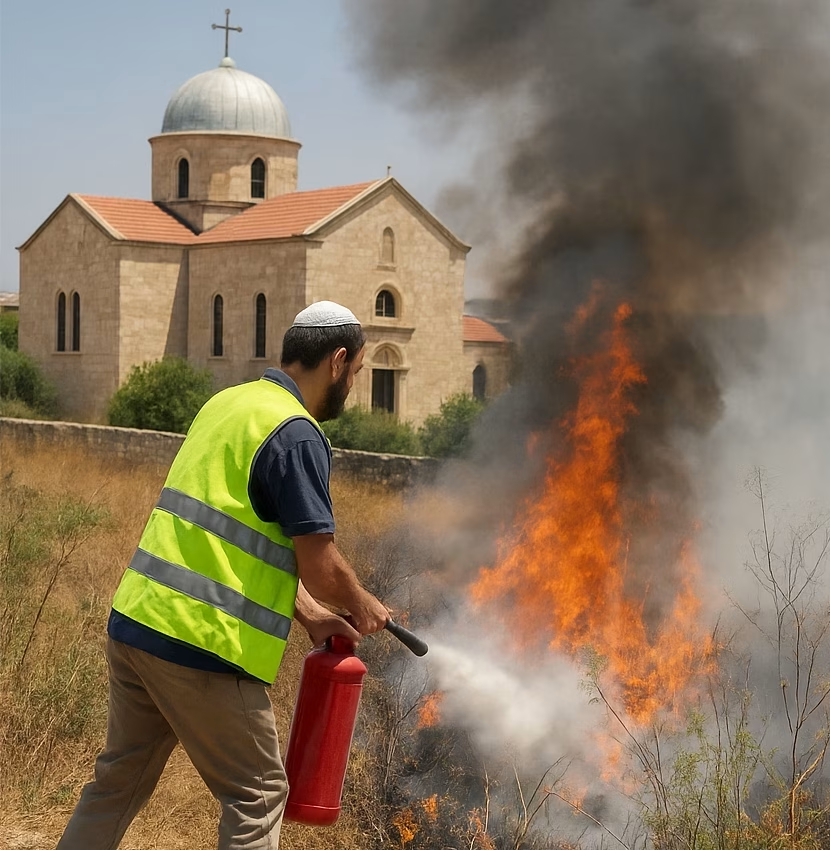
However, TPS reports that video footage and eyewitness testimony complicate the narrative. Their investigation included footage showing young Jewish men from a nearby farm arriving with fire suppression equipment and reflective vests, attempting to extinguish the fire. In a widely circulated social media post that accused the same individuals of arson, one man was seen holding a compressed air blower — typically used to help manage brush fires, not start them.
A local shepherd, who is a minor, told reporters he first saw the fire while tending his animals and tried to put it out using his shirt. He said that he then saw Palestinians leaving the area of the church cemetery, some shouting and throwing objects in his direction.
The incident came after multiple fire-related complaints by a local Jewish farmer, who reported arson near his grazing land on three separate dates in July — just meters from the church property.
Still, local church leaders insist the compound was intentionally targeted and tied the fire to what they describe as escalating settler incursions, harassment, and disruption in the area. A spokesperson for the Latin Patriarchate stated that although video evidence of arson was lacking, the fire followed a pattern of troubling incidents in Taybeh and nearby areas.
The case remains under investigation by Israeli authorities.
In response to the accusations, several Israeli figures have pushed back strongly. Amit Barak, a Christian affairs expert in Israel, called the allegations politically motivated and suggested church leaders were aligning with international organizations hostile to Israel. Israel Ganz, head of the Yesha Council representing West Bank settlers, labeled the accusations “vicious blood libels,” asserting that settlers are being scapegoated in an international campaign against Israel and its settlement movement.
The controversy unfolds against the backdrop of a broader trend affecting Christian communities in Palestinian-controlled areas. According to data from The Jerusalem Center for Security and Foreign Affairs, the Christian population in the West Bank has sharply declined — from 11% in 1922 to just 1% in 2017 — with many citing intimidation and violence from radical Islamist elements as a major driver of emigration.
As the investigation into the Taybeh fire continues, the incident has become a flashpoint in the wider conversation around religious freedom, political manipulation, and the future of Christian communities in the region.