Part I
“I know of no public event that has given me such pleasure as the proposal to establish a Hebrew University in Jerusalem.”—Albert Einstein
The Hebrew University of Jerusalem celebrates its centennial this year, commemorating 100 years of providing “academic and intellectual contributions” to the welfare of humanity, declared Professor Asher Cohen, president of the university.
“For a hundred years,” he said, “the Hebrew University of Jerusalem has been home to exceptional individuals—those who question, who break conventions, who innovate and redefine boundaries. It all began with a pioneering spark in the heart of Jerusalem, shaping the academic landscape of Israel.”
There has always been a “strong bond between academia, industry and the Israeli economy. Since its founding, the Hebrew University has been a catalyst for innovation, technology and economic growth. Our graduates and research have left a lasting impact on both Israeli and global markets.”
He notes that an extraordinary group of intellectual visionaries, including Albert Einstein, Chaim Weizmann, Chaim Nachman Bialik and Martin Buber, joined in the quest of a common vision: the establishment of the Hebrew University.
Laying 12 Foundation Stones On Mount Scopus
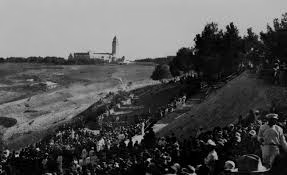
In the afternoon of July 24, 1918, 12 foundation stones of The Hebrew University, one for each of the 12 tribes of Israel, were placed on Mount Scopus. Approximately 6,000 people were in attendance.
Chaim Weizmann, president of the World Zionist Organization, essayist Ahad Ha’am and representatives of all segments of the Jewish people were in attendance, recounts Norman Bentwich, the first attorney general of Mandatory Palestine.
Nachum Sokolow, a member of the executive of the World Zionist Organization, reports that Weizmann laid the first stone on behalf of the Zionist organization. He was followed by the two chief rabbis of Jerusalem and the heads of the Jewish National Council (Va’ad Le’umi), who laid a stone on behalf of the Jerusalem community. The Mufti of Jerusalem laid the next stone, followed by the Anglican Bishop. Other stones were laid on behalf of the Zionist Organization, the Jewish Regiment, Baron Edmond de Rothschild, the town of Jaffa, the Colonies, Hebrew literature, Hebrew teachers, Hebrew science, Jewish artisans and laborers. Isaac Golberg, who largely funded the site, laid a stone, with the final one for the future generations.
Weizmann then signed a parchment scroll with the words inscribed with the blessing: Shehecheyanu, v’kiy’manu, v’higiyanu laz’man hazeh (who has kept us alive, sustained us, and brought us to this season).
He offers a moving account of this event in his memoir “Trial and Error”—“The physical setting of the ceremony was of unforgettable and sublime beauty. The declining sun flooded the hill of Judea and Moab with golden light, and it seemed to me that transfigured heights were watching, wondering, dimly aware perhaps that this was the beginning of the return of their own people after many years.”
He was convinced “that the seers of Israel have not utterly perished, that under the aegis of this University there will be a renaissance of the Divine power of prophetic wisdom that once was ours.”
For William Ormsby-Gore, assistant secretary to the British cabinet headed by Prime Minister David Lloyd George, this was “an event likely to be of great importance in enabling Jerusalem to become a spiritual centre for the still dispersed communities of Israel, and destined, let us hope, to influence and elevate the mental life, social aspirations, and religious conceptions of the Jews of the world.”
He added that the site of the university is beautiful. It is on an estate purchased from the late Sir John Gray Hill of Liverpool, England, “who was personally in deep sympathy with the scheme.” On one side it faces Jerusalem, and on the other, the Jordan Valley and the Dead Sea.
The ceremony did not last more than an hour, Weizmann said. At the end, they sang “Hatikva” and “God Save the King.” “No one seemed anxious to leave, and we stood silent, with bowed heads, round the little row of stones, while the twilight deepened into night.”
Historian Roy McLeod reports that Weizmann commented to his wife, Vera: “The only man who sent a cable [at the stone-laying] was Mr. Balfour. Otherwise, not a single word from my own people, nor from the Zionists or anybody else, and this had a depressing effect on me at any rate.”
Balfour’s cable, which Weizmann read at the ceremony, said: “Please accept my cordial wishes for the future of the Hebrew University on Mount Scopus. May it carry out its noble purpose with ever-increasing success as the years go on. I offer my warm congratulations to all who have laboured so assiduously to found this school of learning, which should be an addition to the forces of progress throughout the world.”
Concept of the University ‘Not a New Idea’
Weizmann points out the proposal for establishing the Hebrew University had been suggested by Zvi Herman Schapira, a math professor at the University of Heidelberg, and in 1884, at the Kattowitz Conference, a convention of Hibbat Zion societies, and then at the First Zionist Congress in 1897, convened in Switzerland on Aug. 29.
Weizmann and his colleagues had organized public support for the university since it provided a “deep-seated need,” he said. Russian schools were systematically excluding Russian Jewish youth. “We felt the pressure in Germany and Switzerland, and part of the stream of migration was diverted to the south, to Italy,” he said. “It seemed logical to seek a partial solution for this homelessness of the young Jewish intellectual in a Hebrew university in Palestine.”
Formal Inauguration
Of The Hebrew UniversityOn April 1, 1925, The Hebrew University campus on Mount Scopus was inaugurated. The American Jewish World reported that a procession of delegates from foreign universities, and numerous Jewish communities and towns from Palestine marched from Jerusalem to Mount Scopus. A choir accompanied them singing “HaShamayim Misaprim Kavod El” (The heavens praise the glory of the Lord) and the British national anthem.
Government and academic representatives from the United States, Italy, France, Belgium, Holland, Greece, Germany, Poland and Austria attended. They were joined by Lord Edmund Allenby, Zeev Jabotinsky, Weizmann, James Rothschild, Bialik, and leaders from Jewish communities around the world.
In total, between 6,000 and 7,000 people attended the ceremony—a huge number considering the population of Jerusalem at the time was less than 60,000.
Prayers were offered by Rabbi Abraham Isaac Kook, Chief Rabbi of Palestine, and Dr. Joseph H. Hertz, Chief Rabbi of Great Britain. Weizmann officially opened The Hebrew University.
Herbert Samuel, the first High Commissioner for Palestine, declared: “The opening of the university marks the brightening of the everlasting lamp which burned through the centuries in every synagogue in the land.” He concluded his speech with the prayer “Shehecheyanu, v’kiy’manu, v’higiyanu laz’man hazeh.”
Dr. Alex Grobman is the senior resident scholar at the John C. Danforth Society, a member of the Council of Scholars for Peace in the Middle East and on the advisory board of the National Christian Leadership Conference of Israel (NCLCI). He has an MA and PhD in contemporary Jewish history from The Hebrew University of Jerusalem.