
Jared Kushner and JD Vance’s proposal to split Gaza into Israeli and Hamas zones promises reconstruction and security. In reality, it risks cementing division and prolonging despair.
The new U.S.–Israeli proposal to divide Gaza into two zones — one under Israeli control and another still ruled by Hamas — is being sold as a pragmatic step toward peace. But beneath the rhetoric of “stability” and “security,” the plan reveals an unsettling logic: manage Gaza, don’t solve it.
At a press conference in Israel this week, Vice President JD Vance and former White House adviser Jared Kushner unveiled a framework they say could “build a new Gaza.” The idea is to rebuild the half of the enclave now controlled by Israel’s military while Hamas is disarmed and eventually removed. Kushner called it a “safe zone” where Palestinians could find “a place to go, a place to get jobs, a place to live.”
It sounds hopeful — but it isn’t peace. It’s partition by another name.
Under the plan, reconstruction funds would flow only to the Israeli-controlled half of Gaza, while the other side, still under Hamas’s control, would remain isolated and under pressure. The intention, Kushner says, is to “geographically expand the safe area” as Hamas weakens. In theory, Gaza’s rebuilt half would become a model for what postwar life could look like. In practice, it risks creating a two-tiered society: one rebuilt, one abandoned.
Arab diplomats immediately condemned the idea. Dividing Gaza, they warn, would entrench a permanent Israeli zone inside the enclave — something no Arab government is willing to endorse or police. For Palestinians, the fear is even more visceral: that “temporary” occupation becomes the new normal, and that Gaza follows the West Bank’s path — fragmented, restricted, and perpetually provisional.
The plan reflects the same underlying problem that has haunted every American initiative since Oslo: treating Palestinian statehood as a reward for good behavior rather than a right of people under occupation. It demands that Hamas disarm — a reasonable goal — but offers no political horizon for what follows. There is no credible framework for governance, no guarantee of sovereignty, and no mechanism for trust.
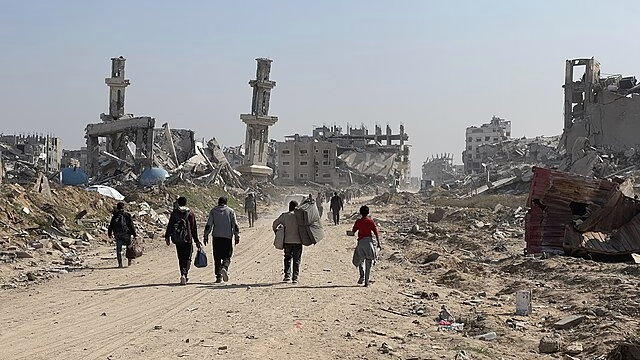
The proposal also misunderstands the human reality of Gaza. After a year of devastating war, most Gazans are displaced, hungry, and grieving. Rebuilding half the strip while walling off the rest may look efficient on paper, but to those living among the ruins, it would feel like collective punishment. How do you tell a mother in Rafah that her home won’t be rebuilt because she lives on the wrong side of a yellow line on a U.S. map?
Kushner and Vance frame their plan as pragmatic — “doable and optimal,” in the words of Israeli analysts who back it. But pragmatism that ignores justice is only a way of postponing conflict. The idea of a “safe” Gaza built under military occupation recalls the failed experiments of past decades: “security zones,” “buffer areas,” and “temporary measures” that somehow always outlast their promises.
Even if reconstruction on the Israeli side begins, it will depend on Israel’s security apparatus, its vetting procedures, and its control over movement — in other words, the same machinery of control that has suffocated Gaza for years. Far from empowering Palestinians, it could reduce them to subcontractors of their own containment.
The Trump administration’s officials insist the plan is only “preliminary,” but its moral implications are clear. It treats peace not as reconciliation, but as a project of engineering — one that can be built, fenced, and funded into existence. It imagines that a divided Gaza will somehow produce unity later, when in reality, it may harden resentment and deepen the very divisions that fuel extremism.
The cease-fire line that now runs through Gaza is meant to shrink over time. But if the past 20 years have taught anything, it’s that temporary lines tend to become permanent borders. A divided Gaza would not mark the beginning of a new era — only the continuation of an old pattern: security for some, stagnation for others, and peace deferred once again.
Real peace requires more than concrete and checkpoints. It demands political courage — from Israelis, Palestinians, and Americans alike — to imagine coexistence, not containment. Without that, Gaza’s reconstruction will be just another mirage in a desert of broken promises.