
Europe’s security crisis is not only a matter of budgets, tanks, or alliances. It is a crisis of conviction.
Recent polling and public commentary suggest a troubling reality: in some of Europe’s largest countries, many citizens doubt they would fight if their homelands were invaded. Political leaders warn—sometimes awkwardly, sometimes bluntly—that the continent is not psychologically prepared for the costs of war. At the same time, Washington’s strategic focus is shifting toward the Western Hemisphere and Asia, with harsher rhetoric about Europe’s reliability, internal cohesion, and political direction. Europe hears the message as an insult. But it is also an alarm.
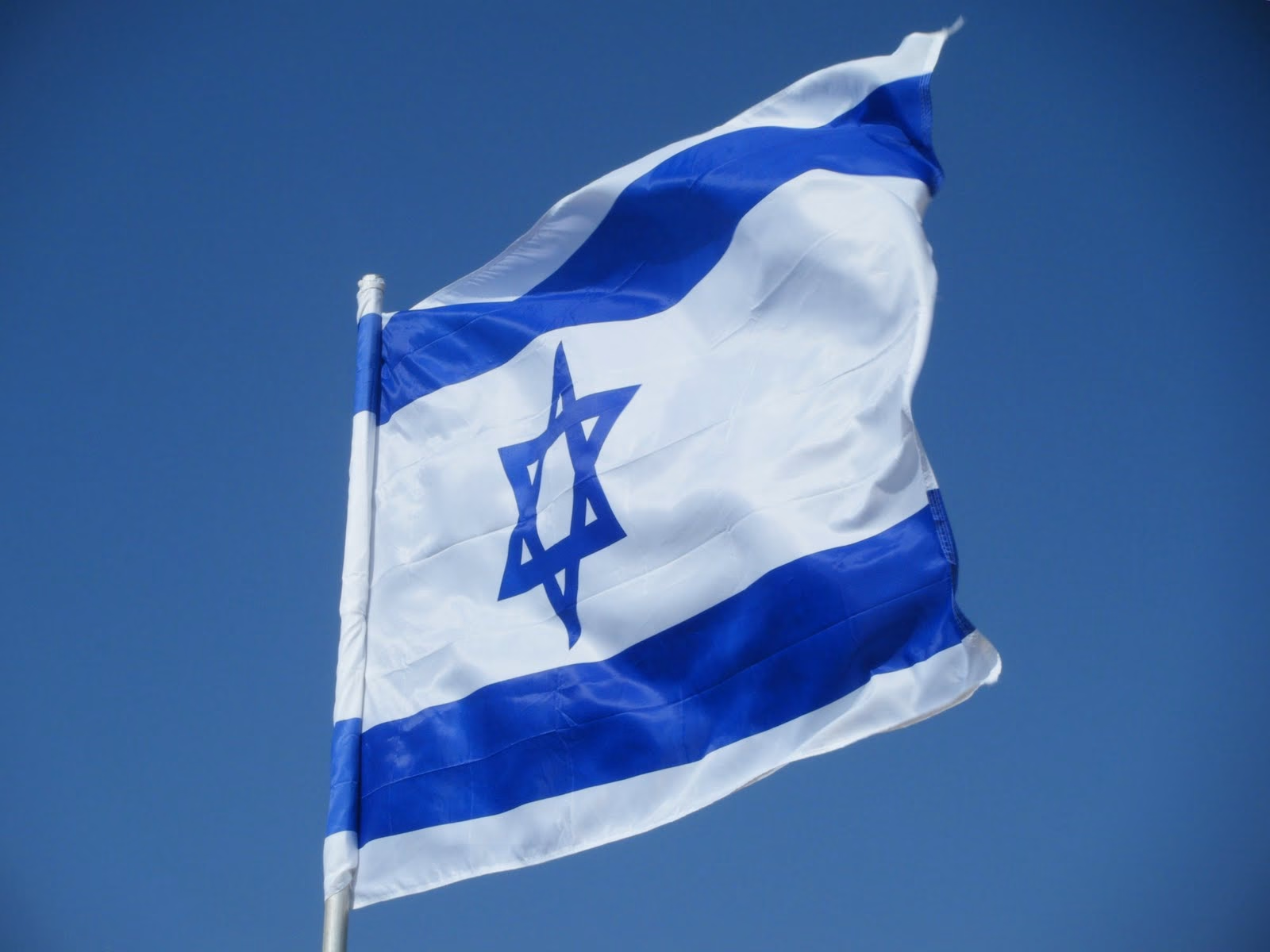
Christians should not watch this debate as detached spectators. The stakes are civilizational in the most practical sense: the preservation of free societies that—however imperfectly—still protect religious liberty, human dignity, and the rule of law. And Christians, in particular, should recognize that Europe’s dilemma is inseparable from another reality the West often tries to compartmentalize: Israel, too, is on the front line of the struggle between democratic self-defense and ideologies that glorify coercion.
Israel understands something Europe has largely forgotten: peace is not sustained by wishes. It is sustained by readiness, unity, and the moral courage to defend what is good.
For decades, many European states have treated security as an imported commodity—purchased indirectly through American guarantees rather than produced domestically through military strength and societal resilience. That arrangement made a certain sense in the shadow of the Cold War, and it bought Europe time to rebuild after catastrophe. But what began as a strategic necessity hardened into a worldview: that history had mellowed, that serious war was obsolete, that the burdens of defense could be perpetually deferred.
Meanwhile, Israel never had that luxury. It was born into existential threats, and it survived because it combined two things modern elites often try to separate: a commitment to democratic life and a willingness to bear the cost of defending it. Israel debates fiercely, protests loudly, and argues constantly—because it is a free society. And when threatened, it mobilizes decisively—because it must. Whatever one thinks of Israel’s politics (and Israelis themselves disagree vehemently), the nation’s underlying posture contains a lesson Europe needs: freedom is not self-executing.
This is not a call for militarism. Christianity does not sanctify violence. But Christian ethics is not pacifism by default, either. Scripture assumes government has responsibilities that include public order and protection of the vulnerable. The Apostle Paul speaks of governing authority as tasked with restraining wrongdoing. The prophets condemn those who “cry peace” when there is no peace. And the story of Nehemiah—rebuilding a shattered city while guarding the walls—captures the realism of faithful people living in dangerous times: “We prayed… and we set a guard.” Prayer and preparation are not opposites; they are partners.
Europe’s problem is that it increasingly wants prayer without preparation—values without vigilance. It wants the benefits of sovereignty without the burdens of sovereignty. It wants an identity broad enough to include everyone, but too thin to inspire sacrifice from anyone.
This is where the debate over immigration, integration, and national cohesion becomes urgent—and morally complicated. The Christian response must reject cruelty and scapegoating. The image of God is not a passport privilege. But the Christian response must also reject naïveté. Welcoming the stranger does not mean abandoning borders, laws, or the legitimate expectations a host society has for shared civic norms. Migration can strengthen nations when it is orderly and paired with integration; it fractures them when it becomes unmanaged, when parallel societies form, and when extremists exploit openness as weakness. A sober, humane immigration policy is not a betrayal of Christian compassion. It is a defense of the social trust that makes compassion sustainable.
Europe must also confront its economic stagnation and strategic dependency. You cannot deter adversaries with conference resolutions. You cannot fund defense with slogans about “sustainable development” while smothering innovation, underinvesting in future industries, and allowing critical supply chains to drift beyond your control. You cannot build credible militaries while treating energy reliability as a moral accessory rather than a strategic necessity. And you cannot preserve peace if your youth have no compelling reason to believe their societies are worth preserving.
Here, too, Israel stands as a rebuke—sometimes uncomfortable, often inconvenient—to Western complacency. Israel has invested in technology, resilience, and security architecture not because it romanticizes conflict, but because it understands deterrence saves lives. The purpose of strength is not domination. It is prevention. It is the ability to say “no” to those who would impose their will through terror or invasion.
That is why Christians should be explicit: standing with Israel is not merely a niche political posture. It is a moral and strategic stance against the normalization of antisemitism and against the global campaign to delegitimize the Jewish state’s right to exist and defend its people. Too many Western debates about Israel slip into moral inversion—treating a democracy protecting its citizens as the problem, while excusing or downplaying actors who target civilians, glorify martyrdom, and weaponize humanitarian language to prolong war. Christians should resist that inversion not because Israel is always right, but because truth matters, and because the God of the Bible does not demand that we be “balanced” between murder and self-defense.
Europe’s leaders often perform symbolic gestures—recognitions, condemnations, declarations—that cost little and change less. But symbolism cannot replace strategy. If Europe wants to remain an independent actor, it must take up the responsibilities that independence requires: rearmament that is real rather than rhetorical; industrial capacity that can sustain conflict rather than merely start it; energy policy grounded in resilience; immigration policy grounded in integration; and a civic culture that teaches gratitude for inherited freedoms rather than suspicion toward them.
Above all, Europe needs a moral recovery. Not nostalgia. Not ethnic chauvinism. Not a bureaucratic identity. A moral recovery rooted in what has historically made European societies worth defending: human dignity, ordered liberty, conscience rights, and the belief—so central to Christianity—that the strong have obligations to protect the weak.
Israel has paid a high price to live out that truth under fire. Europe now faces a choice: learn the lesson, or outsource its future until the outsourcing fails.
Christians should be among the first to say, plainly and without embarrassment: Europe is worth defending. Israel is worth defending. And a civilization that forgets why defense is sometimes necessary will eventually lose the very peace it claims to cherish.