
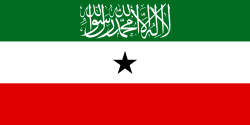
Israel’s decision to recognize Somaliland is already being framed by critics as reckless—an act that could destabilize the Horn of Africa, embolden terrorist groups like Al Shabab, and strain relations with regional powers such as Egypt, Turkey, and the African Union. These concerns should be taken seriously. But seriousness cuts both ways. Reflexive opposition to recognition, rooted more in diplomatic inertia than present realities, obscures both the strategic logic and moral coherence behind Israel’s move.
For more than three decades, Somaliland has functioned as a de facto state. It has maintained relative stability in a volatile region, held elections, built governing institutions, and resisted the very extremist forces—most notably Al Shabab—that plague southern Somalia. The claim that recognition would “bolster” terrorism ignores the empirical record: it is precisely Somaliland’s lack of recognition that has limited its access to formal security partnerships, economic development, and international accountability mechanisms. Isolation does not weaken extremism; it creates the conditions in which it thrives.
Israel’s recognition should be understood through a realist lens. The Jewish state has long faced diplomatic boycotts and automatic majorities against it in international forums. Expanding bilateral recognition—particularly with pragmatic, non-hostile Muslim-majority societies—has been a cornerstone of Israel’s foreign policy since the Abraham Accords. Somaliland fits that pattern. This is not ideological adventurism; it is strategic diversification.
Critics also warn that recognition undermines Somali sovereignty and could encourage secessionist movements elsewhere in Africa. Yet this argument assumes that borders drawn in the colonial era are sacrosanct regardless of subsequent history. Somaliland voluntarily united with Italian Somalia in 1960, suffered systematic repression, and declared independence only after the Somali state collapsed entirely in 1991. Treating that history as irrelevant while insisting on “territorial integrity” reduces international law to a slogan rather than a framework grounded in consent and governance.
Concerns about relations with Egypt and Turkey are real—but manageable. Both countries already maintain diplomatic ties with Israel despite sharp disagreements over Gaza, the Eastern Mediterranean, and political Islam. Disagreement is not rupture. Moreover, Egypt’s opposition is driven less by Somaliland per se than by its own Nile and Red Sea anxieties. That does not obligate Israel to subordinate its strategic interests indefinitely.
None of this means recognition should be unconditional. Allegations of human rights abuses in places like Las Anod warrant scrutiny, and recognition should increase—rather than reduce—international expectations of accountability. But engagement creates leverage; non-recognition creates indifference.
Israel’s decision does not magically resolve Somaliland’s status, nor does it guarantee regional calm. What it does is challenge a stagnant consensus that has failed to produce either stability or justice for over thirty years. In a region where chaos is often rewarded with attention and restraint is punished with neglect, recognizing Somaliland sends a different message: that governance, cooperation, and relative peace matter.
That message may unsettle some. It should. Stagnation has costs, too—and the Horn of Africa has paid them for decades.