
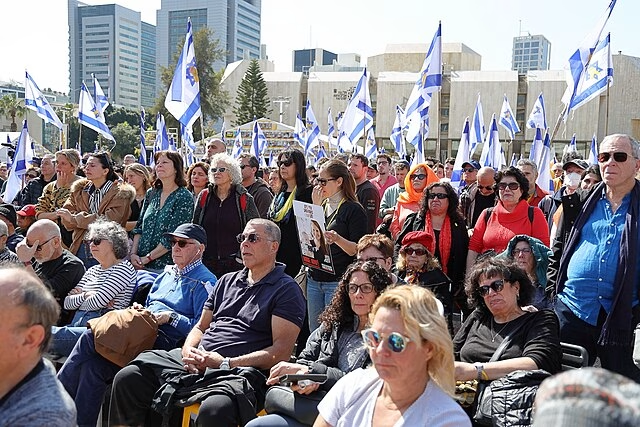
The White House’s new “Gaza Executive Board,” announced as part of President Trump’s 20-point plan for Gaza’s postwar future, was intended to project international unity and accelerate reconstruction. Instead, its composition has exposed a fundamental rift between the United States and Israel—one that cuts to the core of regional security: who will shape Gaza’s political landscape, and whose interests will prevail when Hamas is finally stripped of its ability to terrorize Israelis and Palestinians alike.
Israel’s response was swift and unusually blunt. Prime Minister Benjamin Netanyahu openly rebuked the administration, calling the Board “not coordinated with Israel and contrary to its policy.” The public nature of that criticism is startling only if one ignores the central flaw embedded in Washington’s strategy: the inclusion of Turkey and Qatar—two states that have long served as financial, diplomatic, and ideological lifelines for Hamas.
This is not a matter of diplomatic preference. It is a matter of strategic integrity.
You Cannot Task the Arsonists With Rebuilding the House
For decades, Turkey and Qatar have positioned themselves as patrons of Hamas’s political and military leadership. Doha hosts Hamas’s senior command at its luxury hotels; Ankara gives the group political legitimacy on the world stage. Both governments have spent years shielding Hamas operatives, laundering its rhetoric as “resistance,” and positioning themselves as indispensable intermediaries.
To now place these same actors at the center of Gaza’s reconstruction—without Israeli agreement—amounts to rewarding precisely the behavior that prolonged Gaza’s misery and empowered one of the world’s most entrenched terrorist organizations.
Israeli officials are right to object. As Finance Minister Bezalel Smotrich put it succinctly: “The countries that breathed life into Hamas cannot be the ones to replace it.” That is not ideology—it is basic strategic logic.
A Board with Diplomats but No Palestinians
The irony is glaring: the so-called Gaza Executive Board includes Turkish and Qatari officials, a British former prime minister, an Israeli-Cypriot businessman, Egyptian and Emirati envoys—but not a single Palestinian citizen of Gaza.
This structure may be designed to bypass factional Palestinian politics, but it creates an equally dangerous vacuum: it leaves decision-making in the hands of external players whose interests diverge sharply from each other and from Gaza’s long-term stability.
Turkey seeks regional power projection; Qatar seeks influence through patronage networks; Egypt seeks security along its volatile Sinai frontier; the UAE seeks strategic reshaping of political Islam. Meanwhile Israel—Gaza’s immediate neighbor and the country that must bear the consequences of any failure—finds itself outnumbered by states that have historically viewed the Jewish state as a regional rival.
The Disarmament Problem the U.S. Still Hasn’t Solved
Washington’s plan insists Hamas must disarm. But what the administration has not answered—and what Israel is rightly alarmed by—is who gets to define “disarmament” and who gets to enforce it.
Hamas has indicated a willingness to hand over large weapons like rockets, but refuses to surrender its estimated 60,000 automatic rifles. Without those weapons, Hamas cannot dominate Gaza’s streets; with them, it can metastasize underground and reconstitute itself in months.
Turkey and Qatar have every incentive to argue for a “minimalist” approach to disarmament—one that preserves Hamas’s political relevance and keeps them positioned as its patrons.
Israel, by contrast, has one non-negotiable metric: Hamas must lose the ability to threaten Israeli lives and Palestinian civilians. That means a total, enforceable disarmament—not a diplomatic sleight-of-hand that leaves militants patrolling Gaza under the guise of “local security forces.”
A Committee That Risks Undermining the Cease-Fire
Israel’s pushback is not an act of defiance. It is an act of prevention.
If Turkey and Qatar are empowered to influence Gaza’s political DNA, the cease-fire will be fragile, reconstruction will be distorted by foreign agendas, and Hamas will be given a lifeline at the moment the international community claims to be extinguishing it.
Washington must recognize a simple truth: sustainable peace in Gaza requires empowering actors who seek stability, not those who have spent years fueling extremism.
The Path Forward
A credible Gaza governance plan must adopt three principles:
- Exclude state sponsors of Hamas from oversight roles—not as punishment, but as a prerequisite for restoring trust and security.
- Center Israel’s security imperatives, because no peace plan rooted in denial of Israel’s security reality has ever survived first contact with the Middle East.
- Include legitimate Palestinian technocrats, not foreign governments acting as proxies for armed factions.
The United States remains Israel’s indispensable ally. But allyship is strongest when it is aligned with reality, not aspirational geopolitics. If Washington wants its Gaza plan to succeed, it must take Israel’s warnings seriously.
In the Middle East, the difference between stability and catastrophe often comes down to who sits at the table—and who is foolishly given a microphone.