
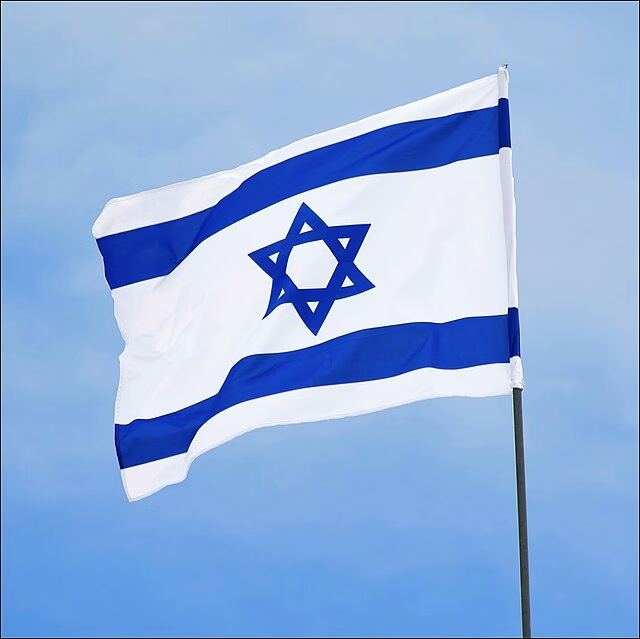
The newly announced truce, brokered under the leadership of Donald Trump and accepted by the government of Israel under Benjamin Netanyahu, offers a temporary pause in violence. But the ambiguity surrounding Hezbollah’s commitment to the agreement reveals the deeper structural problem: Israel can make agreements with states; it cannot make binding peace with militias that operate outside state control.
That distinction matters more than any headline.
Israel has agreed, under the terms outlined by the United States, to halt offensive operations while retaining the right to self-defense. This is not a loophole—it is a necessity. For nearly two decades, since the aftermath of the 2006 Lebanon War, Hezbollah has entrenched itself in southern Lebanon in direct violation of international resolutions, building a hybrid force that combines guerrilla tactics with advanced missile capabilities supplied by Iran.
No responsible government would accept a cease-fire that leaves its northern population centers exposed to an armed group openly committed to its destruction.
Critics often frame Israeli military operations in Lebanon as escalatory. But this framing inverts causality. The current conflict did not emerge in a vacuum; it followed rocket fire launched by Hezbollah in coordination with Iran’s broader regional strategy. When a non-state actor initiates hostilities across an আন্তর্জাতিক border, escalation is not a policy choice—it is a preexisting condition.
The cease-fire, therefore, is not a resolution. It is a pause in an unresolved strategic contradiction.
The Lebanese government, for its part, is being asked to do what it has historically been unable—or unwilling—to do: assert sovereignty over its own territory. The requirement that only Lebanese state forces bear arms in the south is not an Israeli demand alone; it is a restatement of international expectations that have gone unenforced for years. The uncomfortable truth is that Lebanon does not fully control its own security environment. Hezbollah does.
And Hezbollah is not merely a Lebanese actor. It is the most powerful regional proxy of Iran, integrated into a broader axis that includes militias across Syria, Iraq, and beyond. Its strategic calculus is not determined in Beirut alone, but in Tehran. That is why the cease-fire’s durability is tied not just to local conditions, but to the parallel negotiations between the United States and Iran.
In that sense, the border between Israel and Lebanon is only one front in a much larger geopolitical contest.
What, then, should we take from this moment?
First, Israel’s position is often mischaracterized but fundamentally consistent: it seeks enforceable security, not symbolic calm. A cease-fire that allows Hezbollah to rearm, reposition, and resume attacks at will is not peace—it is deferred conflict. History has demonstrated this repeatedly.
Second, the international community’s credibility is on the line. If agreements continue to rely on the assumption that Hezbollah will voluntarily restrain itself without structural change—disarmament, or at minimum, meaningful state control—then these agreements will continue to fail.
Third, and most importantly, moral clarity is required. There is a persistent tendency to treat Israel and Hezbollah as equivalent parties in a symmetrical conflict. They are not. One is a recognized המדינה defending its քաղաքացին; the other is an вооруженный organization designated as a terrorist group by multiple governments, operating outside the framework of international law while embedding itself within civilian populations.
This asymmetry is not rhetorical—it is operational, legal, and ethical.
None of this diminishes the human cost on either side. Lebanese civilians have suffered enormously, as have Israeli communities living under the constant threat of rocket fire. A sustainable peace must address both realities. But compassion cannot come at the expense of clarity about responsibility.
If this cease-fire is to be more than a brief intermission, it must confront the root issue: the existence of an armed, Iranian-backed force operating beyond the control of the Lebanese state on Israel’s northern border.
Until that issue is resolved, every cease-fire will carry the same underlying question:
Not whether the guns will fall silent—but for how long.