
May 20, 2025 5:24 pm IDT
Driving along the perimeter road of the northern Israeli moshav of Yardena, one can see rusting coils of barbed wire – once part of the border fence – now lying discarded on the Jordanian side.
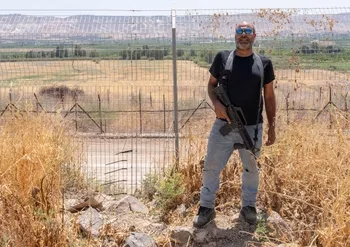
“They were removed a long time ago, and to this day, no new wire has been installed in their place,” Dekel Yosef, the moshav’s security officer, tells Haaretz with frustration. He points to the spot where two Sri Lankan migrant workers cut through the fence and infiltrated the community from Jordan, only to be discovered by a local resident. The breach was made using a wire cutter, and the IDF sealed it with a plastic zip tie.
“These aren’t migrant workers, as far as I’m concerned,” Yosef said. “I’m worried our enemies are testing us. It can’t be a coincidence that on Friday, a Sudanese job seeker infiltrated Kibbutz Sha’ar HaGolan,” about 15 kilometers (approximately 9 miles) from Yardena, “and shouted to kibbutz members to catch him. Then, the very next day, two more infiltrated Yardena, reached the guard post on the western side of the moshav, and just waited to be apprehended.”

Dekel Yosef, security officer at Yardena near the border with Jordan, on Monday.Credit: Daniel Rolider
“For years, the Gaza border communities were lulled into a false sense of security, told that all was well. I won’t tell the residents here, ‘it’ll be okay,’ because it’s not. We don’t need another October 7 attack. All it takes is three terrorists with machetes to infiltrate the community, butcher families and drag a few hostages with them back to Jordan.”
Residents of Kibbutz Sha’ar HaGolan are also concerned. A Sudanese job seeker who infiltrated from Jordan reached the kibbutz’s perimeter fence. Members out for a morning walk passed by him, assuming he was a foreign laborer working in the kibbutz fields, until he approached two of them and asked to be turned over to the police.

Kibbutz Sha’ar HaGolan on Monday.Credit: Daniel Rolider
Sources familiar with the case said the infiltrator is known to the Border Police and had previously entered Israel multiple times for work before being deported.
“Since October 7, 2023, there have been dozens of smuggling and infiltration attempts, from the Dead Sea to Hamat Gader,” says Idan Greenbaum, head of the Emek HaYarden Regional Council.

The belongings caught on the asylum seekers from Sri Lanka.
“In some places, the fence is virtually nonexistent, and you can easily lift or cut through it. A border fence is supposed to function at the very least as an early warning system, but this one doesn’t register anything. This fence belongs in a museum – it’s ancient,” he said.
IDF officials acknowledged the failure and confirmed that an investigation into the recent infiltrations is underway. “We’re facing a significant challenge on the eastern front. We’re responsible for hundreds of kilometers of border, currently monitored by a single brigade,” a military source told Haaretz.
“We’re preparing for more severe scenarios and are in the process of establishing a new division expected to become operational in the area within a few months.” The source praised Jordanian cooperation and emphasized that the army “understands that no defense is impenetrable.”

A breach at the border fence near Yardena, on Monday.
The source noted that considerable resources have been invested in addressing the issue, referring to a statement from the Defense Ministry earlier this week announcing the establishment of a new multilayered defense system along 425 kilometers (approximately 265 miles) of the border, from the southern Golan Heights to the Arava region in southern Israel.
According to the ministry, the system will combine a physical barrier with advanced sensors, detection and alert capabilities, security components, communications infrastructure, command centers and more. This will be complemented by “the deployment of light, flexible and mobile forces adapted to the terrain and evolving security threats.”

A breach at the border fence near Yardena reinforced with zip ties on Monday.Credit: Daniel Rolider
But the press release issued just hours after the infiltration in Yardena does little to reassure Yosef. “They’ve been talking about this barrier for years, and it still hasn’t happened,” he said. “Even if it does, construction isn’t expected to start for several more months, and it’ll take time before the new fence reaches us,” he added, pointing to the cameras installed along the eastern fence of the moshav.
“Even these cameras aren’t military property. We installed them recently. It’s just that the electrician hasn’t yet connected them to the power grid. We’ll have a meeting with the brigade commander tomorrow, and we’ll demand that, in the meantime, the army at least install measures that provide some indication of any contact with the border.”

An open field at Kibbutz Sha’ar HaGolan near the Israel-Jordan border, on Monday.Credit: Daniel Rolider
He adds that the soldiers are not to blame for the infiltrations. “We see the reinforcement of troops, and the community’s security measures have also been boosted following the October 7 massacre. But the army’s manpower is limited. They conduct patrols, yet they’re responsible for a border stretching over 400 kilometers (approximately 240 miles), and mostly patrol by vehicle, which limits their ability to detect every breach in the fence.”
“Five divisions are currently deployed in Gaza because of this government. So, do you expect us to have enough soldiers here to guard the eastern border?”