
The proposal plays into Israel’s plan to divide and conquer the Palestinians of the West Bank
I was 10 when my family left our rented apartment in Hebron’s H2 district, the neighborhood where the Jabari family has lived for generations. We didn’t leave by choice. The violence of the second intifada and the relentless aggression of Israeli settlers made staying impossible. When I read in these pages an extended Jabari family member and four tribal leaders’ claim to speak for Palestinians in Hebron, offering what some are calling a “new path to peace,” I was reminded of an old truth: The most dangerous lies are those wrapped in familiar clothing.
The proposal, championed by Wadee’ al-Jaabari and Israeli Economy Minister Nir Barkat, promises peace through fragmentation, replacing Palestinian national aspirations with a patchwork of local “emirates.” This isn’t new thinking—it’s the colonial playbook. It’s divide and conquer dressed up for a modern audience. The proposal makes Palestinian self-determination impossible, reducing the dream of statehood to a work-permit program. At least the Palestinian Authority, for all its failures, emerged from a national movement.
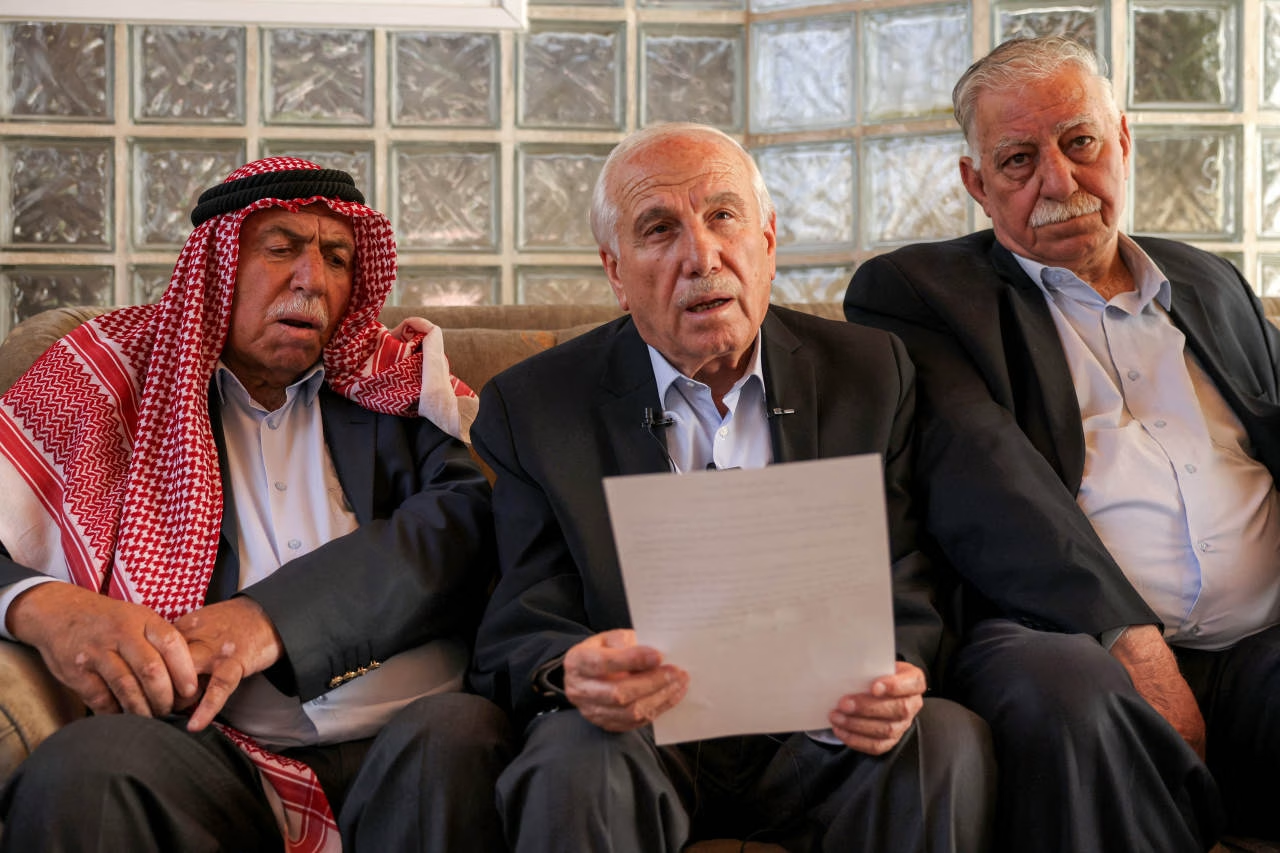
The Journal reports that “Jaabari and four other leading Hebron sheikhs have signed a letter pledging peace and full recognition of Israel as a Jewish state” in return for Israel’s recognition of the “Emirate of Hebron,” with the goal of joining the Abraham Accords. But the Palestine Liberation Organization recognized Israel’s right to exist in 1993. Israel nonetheless established more settlements, more checkpoints and a more entrenched occupation. The settler population nearly doubled during the Oslo years. Now we’re expected to believe that an artificial Hebron emirate recognizing Israel more fully as a Jewish state and joining the Abraham Accords will make things better for Palestinians?
The bitter irony is that Prime Minister Benjamin Netanyahu has acted to fragment Palestinian representation. His government allowed the provision of money to Hamas after its rise to power in Gaza to weaken the Palestinian Authority. At a Likud party conference in 2019, Mr. Netanyahu reportedly said, “This is part of our strategy—to isolate the Palestinians in Gaza from the Palestinians in the West Bank.” The current proposal would give Mr. Netanyahu what he wanted, while promising work permits to Palestinians as a carrot. But we don’t need permission to work in Israel; we need the freedom to build our own economy on our own land.
In the proposal letter, the signatories’ commitment to “zero tolerance” for terrorism by Palestinian workers is particularly galling, coming as it does with the implicit accusation that Palestinian society somehow tolerates violence. Most Palestinians, including those who oppose the occupation most strongly, seek freedom through peaceful means. But when you deny people legitimate political channels for their aspirations, when you close every door to dignity and self-determination, you can’t be surprised when some choose desperate measures.
What makes this proposal especially painful is that it exploits real Palestinian frustration with the Palestinian Authority, which has failed us in many ways. It has become disconnected from the people, more comfortable with the trappings of power in Ramallah than with the hard work of grass-roots engagement. It has tolerated corruption and failed to build momentum toward freedom. But the solution isn’t to abandon the principle of unified Palestinian representation—it’s to demand better from our leaders and to build more accountable institutions.
These pages claimed that Palestinian Authority security forces are unwelcome in certain Hebron neighborhoods because Wadee’ al-Jaabari’s men fire at them when they enter. This ignores that there are places where the Palestinian Authority is absent not because residents reject it, but because Israel restrains it. The Jabari neighborhood is located in Area C, the 60% of the West Bank where Israel prohibits PA security forces from operating and maintains full military control. This is the same sleight of hand that characterizes the entire proposal: Create conditions that fragment Palestinian society, then use that fragmentation to justify further division.
Mr. Barkat says, “nobody in Israel believes in the PA, and you won’t find many Palestinians who do either.” Perhaps. The answer isn’t to replace one flawed system with something worse. Palestinians aren’t asking for Israeli approval of our representatives. We’re asking for the right to choose them ourselves, to shape our own future, to live as a free people in our own land.
Here’s what real peace looks like: Israel ends the war in Gaza and begins negotiations with a reformed and empowered Palestinian Authority and PLO for a credible and irreversible path to a two-state solution based on the June 6, 1967, borders with land swaps; a resolution to the Palestinian refugee issue based on the 2000 Arab Peace Initiative; robust security arrangements that protect both peoples through cooperation, not domination; and a Marshall Plan-style investment program that builds the Palestinian economy from the ground up, including in Gaza.
Most important, this process must be led by a young generation of Palestinian leaders, most of whom have never had an opportunity to vote in a Palestinian election and have only known occupation but refuse to accept it.
Mr. Jabari is a Geneva-based international-affairs analyst.