
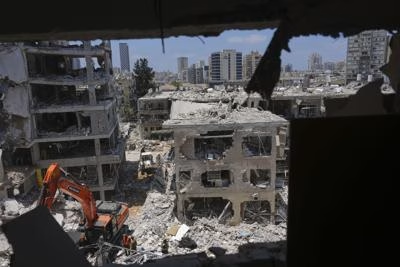
In the chorus of international outrage surrounding the Israel–Hamas war, the word genocide has become a constant refrain. It’s been painted on protest signs, shouted from podiums, and debated in courtrooms. For many Israelis and Jews around the world, it’s a deeply offensive accusation—a label that invokes the worst crimes of human history, including those committed against our own people. It feels grotesquely inaccurate, and for many, it feels intentionally weaponized.
But here’s the uncomfortable truth: we’ve become so focused on disproving the charge that we’ve stopped asking whether what we’re doing is just.
A recent post titled “Who cares if they say it’s genocide?” cut to the heart of that moral disorientation. It argues that, in the face of brutal war, the public discourse has collapsed into a binary: either we are valiantly defending ourselves from a genocidal terrorist threat, or we are the perpetrators of genocide ourselves. And because the second is clearly false, many have taken comfort in assuming the first is unquestionably true.
But morality doesn’t live in binaries. Wars—even just wars—can be fought unjustly. Defense can become disproportionate. Trauma can turn into vengeance. And when the moral compass becomes “at least we’re not committing genocide”, we’ve set the bar dangerously low.
Not Genocide—But Still a Catastrophe
No serious moral or legal thinker believes the only metric for injustice is genocide. That word has a specific definition: the intent to destroy a people in whole or in part. Despite some unhinged rhetoric from fringe Israeli politicians, the state of Israel is not engaged in the systematic extermination of Palestinians. But that doesn’t mean the war in Gaza isn’t catastrophic.
Tens of thousands of civilians are dead. Entire neighborhoods are gone. Families are living through starvation, displacement, and hopelessness. Children are growing up with nothing but the sound of drones, the rubble of schools, and the memory of violence. This is not normal. This is not sustainable. And it is not okay.
There are many reasons for how we got here—some military, some political, and some emotional. The IDF is operating in an environment it was never built for: dense urban warfare against an enemy embedded in civilian infrastructure. Hamas commits war crimes daily by hiding behind human shields and building tunnels under hospitals. But the scale and duration of this war have gone far beyond “surgical” or “precise.” And while Hamas may have engineered the crisis, Israel has perpetuated it.
Meanwhile, the political leadership benefits from the chaos. A government teetering on the edge of collapse has found new life in a state of emergency. Elections are postponed. Investigations are shelved. Rage is redirected outward. There is no vision for the “day after,” only an ever-receding goalpost called “total victory.”
And beneath it all simmers a national trauma. October 7 was a waking nightmare—an abomination. Entire families were butchered. Young people gunned down. Hostages taken. For many Israelis, that day shattered the illusion of safety and sparked a deep, almost existential fear. But fear, when left untreated, calcifies into something darker. Into numbness. Into indifference. Into the justification of almost anything—so long as it brings back a sense of control.
We Must Care What They Say—Not Because They’re Right, But Because We Might Be Wrong
So who cares if they say it’s genocide?
We should.
Not because it’s legally true, but because the accusation should jolt us into honest self-examination. Because when the world sees a humanitarian catastrophe and we respond only with legalese, something has gone wrong in our moral imagination.
Yes, we must fight terror. Yes, we have the right to self-defense. Yes, Hamas is an enemy of peace, of Israel, of Palestinians themselves. But no, not everything done in the name of defense is defensible. The destruction in Gaza has reached a scale that demands soul-searching—not just PR rebuttals.
There is a Jewish value that too often goes unspoken in wartime: cheshbon hanefesh—a spiritual accounting. It’s the practice of stepping back, removing the armor, and asking: who are we becoming? What are we doing in the name of survival? And at what cost to our soul?
To care whether others call this genocide isn’t about capitulating to slander. It’s about caring enough about justice, life, and conscience to ask the harder question: if it’s not genocide—then what is it? And are we still the kind of people who can look at this war and say: this is necessary, this is proportionate, this is right?
If the answer is no—or even “I’m not sure anymore”—then the time has come for something braver than defensiveness. The time has come for a reckoning.
Let me know if you’d like this adapted for a specific audience—faith-based, interfaith, Jewish, Israeli, or international.