
The Jewish Link – Part XI
By Alex Grobman, PhD
Jewish reactions to the idea of a two-state solution varied for different reasons, asserted the Esco Foundation for Palestine (ESCO), a private Zionist family foundation set up in 1940 by Frank and Ethel Cohen.
One group opposed the concept, as it would doom the possibility of establishing a Jewish state in all of Palestine. The non-Zionists rejected partition because they categorically opposed any idea of a Jewish state, fearing that reconstituting the Jews as a political body would somehow jeopardize their rights as citizens in their own and other countries. Others claimed a small state in the modern world would not be economically sustainable or militarily defensible.
ESCO adds that still other Jews enthusiastically endorsed partition because this was the first time an explicit mention was made about Jewish statehood since the Jews were dispersed in the Diaspora. There were those who believed that the establishment of a Jewish state would improve relations with the Arabs, as the Jews would assist them in a number of areas, including economics and defense.
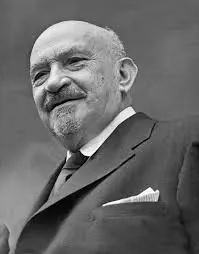
Chaim Weizmann and Partition
Chaim Weizmann became the principal advocate and spokesman for partition in the Council of the Jewish Agency, which represented the Jewish people, and played a critical role dealing with the British during the Palestine Mandate. Additional support came from the Zionist Congress, originating primarily from the General Zionists and Labor Party.
Weizmann viewed partition as the best option, stressing that the Royal Commission had recommended that if partition was not approved, there should be severe limitations on Jewish immigration. He acknowledged that partition was inadequate, but a small Jewish state would be better than having Jews consigned to a minority status in a belligerent Arab state or a federation of states.
Isaac Gruenbaum, a member of the Zionist Executive, framed the choice in this way:
“The alternative is either a Jewish majority in a Jewish State, or a Jewish minority in an Arab Palestine.”
Opposition Voices
ESCO reports that opposition within the Zionist Congress to partition was represented by diverse groups and individuals—the Mizrachi, Hashomer Hatzair, the extreme right of the Labor Federation, and the State Party, whose program was similar to that of the Revisionists.
In America, Hadassah, Judge Julian W. Mack, Judge Louis Dembitz of the Brandeis group, and the American Economic Committee for Palestine were leading opponents. Menachem Ussishkin, president of the Jewish National Fund, was the “outstanding spokesman against partition at the Zionist Congress.”
The anti-partition groups were critical of Weizmann for not accurately explaining the options to respond to the partition proposal. They argued that if serious challenges had been mounted to attempts to repudiate the Mandate, the British government would have been compelled to keep the pledge without any changes.
Non-Zionist Perspectives
At the Council of the Jewish Agency, ESCO notes that Felix M. Warburg, banker, philanthropist and leading Jewish communal leader, completely opposed the concept of a Jewish state.
Maurice Karf, a non-Zionist member of the Executive of the Jewish Agency for Palestine, explained that they did not want to bring public attention to the nature of Jewish life:
“They were interested in the upbuilding of Palestine as a place of refuge, as a cultural center for the Jewish people.”
Dr. Judah L. Magnes, president of The Hebrew University of Jerusalem, opposed partition largely because the Arabs were against it.
Norman Bentwich, the British-appointed attorney general of Mandatory Palestine, noted that Magnes and a number of Jewish intellectual leaders started a movement called Brit Shalom (League of Peace) to promote better relations between Jews and Arabs. A number of professors and staff of The Hebrew University, several prominent publicists, and Albert Einstein were members.
One Official British Perspective
“It is a great mistake to believe that the difference between moderate Zionists and extreme Zionists is one of principle,” observed Richard Crossman, British Labor M.P., who served as a member of the 1946 Anglo-American Committee of Inquiry.
“Weizmann, Magnes, and Ben-Gurion are in complete agreement about the objective: the establishment of a Jewish commonwealth in Palestine. On this, Magnes is just as extreme as a member of the Stern Gang [armed underground organization].
What they differ in is about tactics. Weizmann, for instance, thinks it was a mistake tactically to demand a Jewish state at all. But they all want to see the Jews as much at home in Palestine as the Americans are in America. The moderates think they can achieve this best step by step in collaboration with Britain. The extremists believe that British interests conflict with their aims and that the only way they can win is by proving that it’s more difficult for the British to liquidate the national home than to stand up to Arab opposition.
And part of the trouble is that the attitude of the administration out here certainly makes it look as though the extremists are right. If we want to give moderates like Dr. Weizmann a chance to liquidate their own extremists, there’ll have to be a transformation in the attitude of the British officials. I wonder if that is really possible.”
About the Author
Dr. Alex Grobman is the senior resident scholar at the John C. Danforth Society, a member of the Council of Scholars for Peace in the Middle East, and on the advisory board of the National Christian Leadership Conference of Israel (NCLCI). He has an MA and PhD in contemporary Jewish history from The Hebrew University of Jerusalem.