
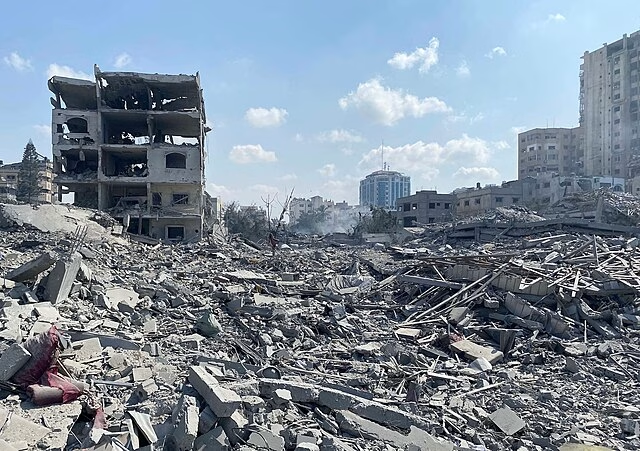
The announcement that the U.S.-backed Gaza Humanitarian Foundation (GHF) is winding down its operations after delivering more than 187 million free meals to Palestinians in Gaza should be understood for what it is: a quiet, stunning rebuke to the old way of doing “humanitarian” work in the Strip — and a vindication of Israel’s insistence that aid can be delivered without empowering Hamas. (Fox News)
In just under five months, GHF built and proved a model that many in the international community spent years claiming was impossible. Working with local Gazan staff, U.S. veterans, Israeli authorities and partners like Samaritan’s Purse, the foundation managed to deliver millions of food boxes — including over 1.1 million packs of supplementary food for malnourished children — while preventing looting and diversion by Hamas. Not a single GHF truck was looted during its entire mission. (Fox News)
That outcome matters far beyond the technical details of logistics. It cuts to the heart of a central accusation repeatedly leveled at Israel: that any attempt to tighten control over the flow of aid is inherently cruel, an act of “collective punishment.” GHF has just shown the opposite. When you combine security, accountability and moral clarity, you can protect civilians and deny oxygen to terrorists.
Hamas Created the Crisis — Then Tried to Own the Aid
It is essential to remember what made GHF necessary in the first place. On October 7, 2023, Hamas invaded Israel, murdering over 1,200 people, including more than 40 Americans, and kidnapping 251 hostages. (Fox News) This atrocity triggered the war that devastated Gaza’s infrastructure and plunged its population into deeper hardship.
For years, Israeli officials and many independent observers warned that the existing humanitarian system in Gaza — dominated by U.N. agencies like UNRWA — had become structurally compromised. Terror tunnels under U.N. schools, Hamas control over distribution networks, and a pattern of aid theft were not glitches; they were features of a system that treated Hamas as a de facto governing partner rather than a genocidal jihadist organization.
When Israel attempted to impose more rigorous inspections and routing for aid convoys, it was accused of “starvation tactics.” Yet those same critics offered no workable plan for keeping food out of Hamas’s hands. GHF stepped into that vacuum with a bluntly different premise: aid must reach civilians directly, without enriching or legitimizing Hamas.
A Model That Worked — and Made Its Enemies Uncomfortable
From its launch in late May, GHF coordinated closely with the Israel Defense Forces (IDF) and the newly created Civil-Military Coordination Center (CMCC) to secure corridors, organize distribution points, and adapt routes in real time as the battlefield shifted. (Fox News)
This required something many U.N. agencies refused to do: honest, practical cooperation with the IDF. In August, a whistleblower told Fox News Digital that the IDF was actively helping GHF get food into civilians’ hands, while U.N. bodies like the World Food Program (WFP) and OCHA were actually inhibiting distribution by refusing to coordinate. A U.N. spokesman dismissed this as “delusional.” (Fox News) Yet the record speaks for itself: U.N. agencies struggled with theft and chaos, while GHF reported zero truck diversions and steadily expanding operations.
The success clearly rattled parts of the humanitarian establishment. UNRWA’s commissioner-general denounced GHF as providing “nothing but starvation and gunfire” to Gazans — a grotesque smear that turned reality upside down. (Fox News) In fact, GHF was literally feeding people whom U.N. convoys often could not safely reach, and doing so with strict controls that kept Hamas at bay.
Why such hostility? Because GHF exposed an uncomfortable truth: the old model was not merely dysfunctional; it had become politically invested in preserving Hamas’s role and in marginalizing Israel. If a U.S.- and Israel-backed NGO could outperform massive, well-funded U.N bureaucracies in both effectiveness and integrity, then their moral authority — and budgets — would be up for debate.
American Leadership, Israeli Security, and Real Compassion
GHF’s leadership has been explicit: this was an American-led, innovation-driven project that depended on close partnership with Israel and a clear-eyed understanding of who the enemy is. They have publicly credited President Donald Trump for early and decisive backing, both financially and politically, to move quickly and think differently. (The Daily Signal)
This is what pro-Israel policy, rightly understood, looks like:
- It recognizes Hamas as the root cause of Gaza’s misery, not Israel.
- It insists that aid be delivered in ways that do not reward or entrench terrorism.
- It treats Israeli security concerns as legitimate, not as an obstacle to compassion.
- And it demonstrates that “America First” doesn’t mean “America indifferent” — it means America leading with principles, not outsourcing moral responsibility to broken institutions.
Trump’s stated peace vision for Gaza explicitly excludes Hamas from any role in governing the territory and calls for its total disarmament. (Fox News) GHF, in a sense, has been a real-time case study in what post-Hamas humanitarian policy could look like: secure, accountable, locally engaged, and anchored in partnership with Israel rather than in hostility toward it.
Passing the Baton, Not Walking Away
Critics will seize on GHF’s exit as proof that the experiment “failed.” That is precisely backwards.
From the beginning, GHF’s leaders said their mission was temporary: to meet an urgent need, prove a new model could work, and then hand it off. Now, with the CMCC and other organizations poised to adopt elements of that model, GHF is doing exactly what it promised — winding down while remaining ready to surge back if new crises arise. (Fox News)
Far from a retreat, this is a hand-off. It says: “Here is a blueprint for how to feed Gazans without feeding Hamas. You have no excuse not to use it.”
It is also a deeply human story. GHF staff have spoken movingly about the relationships they formed with local women and children, and how sites that were once tense became safe places where families returned daily — not because they were forced, but because they trusted the people protecting and feeding them. (Fox News) That trust was not built on anti-Israel slogans or UNRWA posters. It was built on showing up, day after day, with food that actually arrived, in a framework that respected Israeli security and Gazan dignity at the same time.
A Challenge to the “Peace Industry”
In the coming days, you will see a flurry of stories painting GHF as “controversial,” “militarized,” or “politicized.” Some will point to tragic incidents and contested reports of violence near distribution sites as if those erase the 187 million meals that did reach hungry people. (AP News)
No honest observer denies that operating in an active war zone involves risk and tragedy. But we should be clear about what is really “politicized” here. An aid model that reduces Hamas’s leverage, that holds local partners accountable, and that cooperates with the IDF will always be attacked by those whose institutions and narratives are built on blaming Israel first.
For pro-Israel Americans — especially conservatives and Christians — the GHF story is a call to reject the lazy relativism that treats Israel and Hamas as two sides of the same coin, or that shrugs while U.N. agencies preside over chaos. If we truly care about Palestinian lives, we must support models that starve Hamas, not children.
Israel has paid a staggering price to dismantle a terror regime that committed a pogrom on October 7. The least the world can do is ensure that humanitarian aid, ostensibly meant for civilians, is not turned into yet another weapon against the Jewish state.
GHF has shown that this is possible. That is a victory not only for Israel, but for every Palestinian mother who received food for her children without having to pass through Hamas’s grip. The next phase of humanitarian work in Gaza will test whether the world learned anything from that success — or whether ideology will once again triumph over compassion and common sense.