
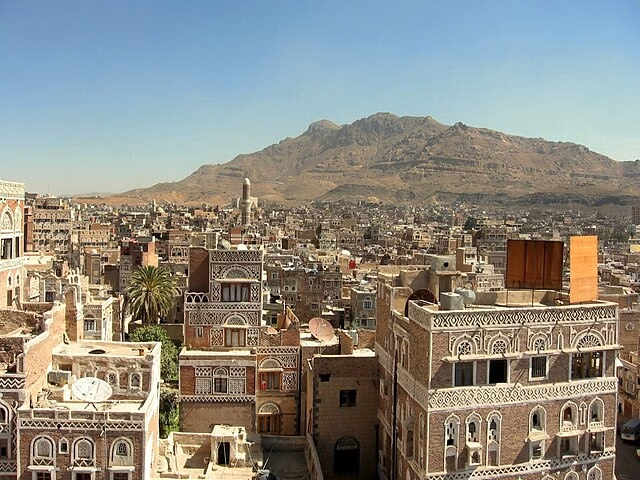
When most Western policymakers look at Yemen, they still see a tragic but “local” civil war, best handled with UN statements and process-heavy peace plans. Israel cannot afford that illusion. The sudden advance of the Emirati-backed Southern Transitional Council (STC) across southern and eastern Yemen, and its stated intention to make a run on the Houthi-held capital of Sanaa, is not a side show. It is the latest turn in the same regional struggle that has brought Hamas rockets from Gaza, Hezbollah missiles from Lebanon, and drone and missile fire from Yemen toward Israel and critical global shipping lanes.
Over the past week, STC forces have taken control of swaths of Hadramaut and Mahra, oil-rich and strategically located provinces that had previously been under forces aligned with Yemen’s internationally recognized government and backed by Saudi Arabia.(AP News) The STC now effectively dominates the territory of the former South Yemen and openly speaks of building institutions for a future “south Arabian state.”(The Guardian) Its leader, Aidarous al-Zubaidi, has declared that “the next goal must be Sanaa, peacefully or through war,” a direct challenge not only to the Iran-backed Houthis who seized the capital in 2014, but also to the legal fiction of a united Yemeni state long favored in Western diplomacy.
For Israel and its partners, the key question is not whether Yemen stays formally united on paper. It is whether Iran’s most aggressive southern proxy will continue to hold a capital city and a coastline that give Tehran leverage over two critical maritime chokepoints and a direct line of attack toward Israel.
The Houthis are not just another Yemeni faction with grievances about corruption and marginalization. They are a core component of Iran’s “axis of resistance,” armed, trained, and supplied by the Islamic Revolutionary Guard Corps and its Lebanese Hezbollah adjunct.(Wikipedia) Their slogan, shouted at rallies and painted on walls, literally calls for death to America and death to Israel. Since October 2023, they have demonstrated both intent and capability, firing missiles and armed drones toward Eilat and at vessels linked (sometimes tenuously) to Israel or its partners, helping trigger what has become known as the Red Sea crisis.(Wikipedia)
Those attacks are not a sideshow. They have already forced shipping companies to divert traffic away from the Red Sea and the Bab el-Mandeb Strait, rerouting vessels around the Cape of Good Hope at enormous cost. The Houthis, with Iranian assistance, have shown they can threaten global energy flows, world trade, and Israel’s access to the Indian Ocean.(Wikipedia) In other words, Yemen is now the southern theatre of the same war Israel is fighting on its northern and western fronts.
Against that backdrop, the STC’s rise presents both risks and opportunities for Israel.
On the one hand, the STC is a separatist militia, not a Jeffersonian democracy. It has its own history of power struggles and abuses. Its lightning offensive has already sharpened tensions between Saudi Arabia and the United Arab Emirates, the two Gulf powers whose uneasy partnership has underpinned the anti-Houthi coalition for the past decade.(Financial Times) Riyadh, which has been searching for an exit from a costly war, suddenly finds its preferred Yemeni partners losing ground to an actor more closely tied to Abu Dhabi. The risk of further fragmentation and intra-coalition conflict is real.
On the other hand, the alternative to STC dominance in the south is not Scandinavian social democracy. It is the consolidation of an Iranian satellite on the southern tip of the Arabian Peninsula, with the ability to menace shipping in the Red Sea and Gulf of Aden, threaten Saudi Arabia from the south, and harass Israel from more than one direction. Viewed through that lens, the STC’s expansion into Hadramaut and Mahra—territories used as corridors for smuggling weapons, money, and fighters—has at least one redeeming feature: it complicates the Houthis’ logistical lifelines.(AP News)
It is telling that many Western diplomats and UN officials reflexively worry more about Yemen’s formal territorial unity than about the reality of an entrenched, heavily armed Iranian proxy ruling the capital and the coast. Some have spoken of their preference for a federal Yemen that would integrate the Houthis into a power-sharing arrangement, effectively rewarding a decade of armed takeover.(The Guardian) That might tick the boxes of conflict-resolution theory. It does nothing to address the fact that the same group has spent the past two years firing missiles at Israeli territory and strangling global maritime trade in solidarity with Hamas.
Israel should be clear-eyed: a “solution” that institutionalizes Houthi control of Sanaa and the Red Sea coast is not a peace plan; it is a recipe for permanent, Iranian-engineered instability on one of Israel’s most vital sea lanes.
None of this means Israel should rush to endorse southern secession or insert itself openly into Yemen’s byzantine factional politics. It does mean that Jerusalem should quietly align its strategic assumptions with those of its most serious Gulf partners:
- A Yemen dominated by the Houthis and their Iranian patrons is intolerable.
- Keeping the Bab el-Mandeb Strait open and secure is a core shared interest of Israel, Saudi Arabia, the UAE, Egypt, and the wider West.
- Any political framework that treats the Houthis as a legitimate governing partner while ignoring their regional aggression is detached from reality.
Practically, that implies several steps.
First, Israel should deepen quiet security coordination with Saudi Arabia, the UAE, and Egypt regarding maritime surveillance, missile defense, and intelligence-sharing in the Red Sea and Gulf of Aden. The Houthis have already demonstrated the ability—thanks largely to Iranian technology—to project power far beyond Yemen’s borders. Countering that threat requires an integrated regional response, not a patchwork of unilateral airstrikes.(Wikipedia)
Second, Israeli diplomacy in Washington and European capitals should hammer home a simple message: Yemen policy is now Israel policy. The same governments that rightly decry Houthi attacks on shipping should be pressed to abandon fantasies of legitimizing a militia that proudly declares its goal of destroying Israel. Conditioning any reconstruction aid or formal recognition on the dismantling of Houthi long-range missile and drone capabilities, and on verifiable curbs on Iranian support, should be a minimum demand.
Third, while maintaining an appropriate distance from Yemen’s internal map-drawing, Israel should be open to the idea that a more autonomous or even independent south—aligned with the Gulf, focused on securing trade routes, and not ideologically committed to Israel’s destruction—is preferable to the status quo. That is not an endorsement of every move the STC makes; it is a recognition that, in the real world, imperfect partners who share core security interests are better than fanatical enemies armed by Tehran.
Finally, Israel’s own national-security thinking must internalize that its struggle with Iran is not confined to the Levant. From the Red Sea to the Mediterranean, from Sanaa to Beirut, Tehran is methodically building a ring of fire around the Jewish state and its allies. Yemen is no longer a distant humanitarian tragedy; it is a southern front in that larger war.
Maps can take decades to catch up with realities on the ground. In Yemen, those realities are shifting quickly. The question for Israel and the West is whether they will continue to cling to lines drawn in 1990, or whether they will confront the danger of an entrenched Houthi-Iranian mini-empire on the shores of one of the world’s most important sea lanes.
For anyone who cares about Israel’s security, global trade, and the stability of the wider Middle East, the answer should be obvious: the battle for Sanaa is not just Yemen’s problem. It is ours.