
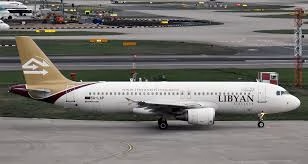
The death of Libya’s top military officer, Lt. Gen. Mohamed Ali Ahmed al-Haddad, in a plane crash outside Ankara is first a human catastrophe—seven lives lost, families shattered, and a nation plunged into mourning. But it is also a political warning flare. Libya’s institutions remain fragile, its security sector contested, and its external patrons deeply enmeshed. In that kind of environment, “peace processes” and “normalization” don’t fail because people dislike the idea of peace; they fail because states without durable institutions cannot reliably keep promises, enforce agreements, or protect their own sovereignty.
General al-Haddad and other senior officials were returning from high-level defense talks in Turkey when their Dassault Falcon 50 reportedly suffered an electrical failure after takeoff, requested an emergency landing, and then disappeared from radar before crashing near Haymana; Turkish authorities recovered flight recorders and opened an investigation. (Reuters) Libya’s Government of National Unity (GNU) declared days of mourning—an acknowledgement that, in a divided country, senior military leadership is not easily replaced. (Reuters)
The core issue is not the crash; it’s what the crash exposes
Libya has effectively remained split between competing centers of power since the post-Qaddafi turmoil: the Tripoli-based GNU in the west and an eastern camp aligned with Khalifa Haftar and affiliated political institutions. (Atlantic Council) That division is not merely constitutional—it is military, economic, and foreign-backed. Turkey’s role exemplifies the problem: Ankara is a principal supporter of the Tripoli government and has sustained a security footprint and defense cooperation that shapes Libya’s balance of power. (Reuters)
When a state’s cohesion depends on personalities and external scaffolding, a single night can alter strategic calculations. That is why the deaths of senior officers matter far beyond protocol. Whether al-Haddad was a unifier, a factional manager, or simply the most senior uniformed official, his loss highlights a recurring regional truth: stability is not achieved by slogans, summits, or hashtags. It is achieved by professional institutions—especially security institutions—that are accountable to a legitimate state and capable of monopoly over force.
What this has to do with Israel
At first glance, Libya’s tragedy looks peripheral to Israel’s strategic map. It should not. Libya sits on the southern Mediterranean, touching Europe’s most sensitive fault lines: irregular migration routes, transnational smuggling networks, and the security of maritime corridors. A Libya that is fragmented is a Libya that can be exploited—by violent extremists, by organized crime, and by regional actors that thrive when governance collapses.
Israel’s security doctrine has always understood that state failure creates launchpads for threats. In the last decade, Israeli policymakers—and many in the broader pro-Israel coalition—have also championed a second insight: regional partnerships are not a luxury, but a force multiplier. The Abraham Accords logic was never merely “make friends.” It was: align pragmatic states around shared interests—security cooperation, intelligence exchange, energy infrastructure, and economic connectivity.
Libya, in theory, is a candidate for that pragmatic architecture. In practice, Libya illustrates the limits of normalization when domestic legitimacy is weak. The 2023 uproar after revelations of a meeting between Libya’s foreign minister and Israel’s foreign minister—followed by political backlash in Tripoli—showed that discreet diplomacy can be necessary, but careless publicity can be destabilizing. (The Washington Post) The lesson for Israel and its partners is not “avoid Libya.” It is “treat institution-building as the prerequisite for any lasting diplomatic breakthrough.”
A Christian pro-Israel framing: realism with moral clarity
A Christian perspective should begin with humility and grief. Scripture’s insistence on the dignity of every human life is not a talking point; it is an ethical constraint. Libya’s dead are not chess pieces. Their families deserve truth—about what happened, why, and whether negligence played a role. Turkey and Libya’s investigation should be thorough and transparent.
But Christian ethics also rejects the sentimentalism that confuses wishes with policies. “Blessed are the peacemakers” is not a call to deny threats or whitewash instability; it is a call to pursue the kind of peace that can endure—peace grounded in justice, order, and truth. In the Middle East and North Africa, that means strengthening state legitimacy and reducing the space in which armed factions operate.
Pro-Israel advocacy, at its best, combines moral clarity about Israel’s right to exist and defend itself with strategic realism about the neighborhood Israel inhabits. Libya’s crash is a reminder that the neighborhood’s biggest danger is not only ideological hostility; it is institutional collapse.
What a constructive pro-Israel policy posture should advocate now
- Prioritize sovereignty over spectacle.
Libya’s 2023 flare-up around Israel contact demonstrated that premature, public-facing breakthroughs can backfire when domestic politics are volatile. (The Washington Post) Israel and its allies should favor steady, low-drama engagement tied to concrete deliverables: maritime security, counter-smuggling, and technical assistance—where invited and feasible. - Support security-sector professionalism as a peace strategy.
If Libya’s forces remain fragmented, any agreement—on border control, terrorism, migration, or regional cooperation—will be episodic at best. Western partners often talk about elections as the sole benchmark; elections matter, but professional security institutions are what prevent election results from becoming triggers for renewed conflict. - Treat external meddling as a regional risk factor.
Turkey’s deep role in Libya is a reality, and it is not the only external influence. (Reuters) The pro-Israel community should be consistent: sovereignty is the antidote to proxy politics. The objective is not to “pick a patron,” but to shrink the proxy battlefield by expanding the legitimate state’s capacity. - Connect Mediterranean stability to Israel’s broader normalization agenda.
The Accords vision should widen beyond bilateral photo-ops to include a regional stability doctrine: reducing ungoverned spaces, increasing joint maritime awareness, and hardening critical infrastructure. Libya’s instability is part of the same security ecosystem that affects Israel, Egypt, Greece, Cyprus, and European partners.
The conclusion Libya forces on us
Libya will mourn, investigate, and eventually appoint successors. (Reuters) But the deeper question will remain: can Libya become a functioning state whose institutions outlast individuals?
For Israel—and for Christians who support Israel not as a mascot but as a nation with legitimate security needs—this moment argues for a sober kind of solidarity. Not triumphalism. Not naïve optimism. Solidarity that tells the truth: peace is built when states can govern, protect their citizens, and resist being turned into arenas for other people’s wars.
Pray for Libya’s bereaved. Demand truth about the crash. And insist, in every regional conversation about “peace,” that the hard work of institution-building is not a detour from peace—it is the road to it.