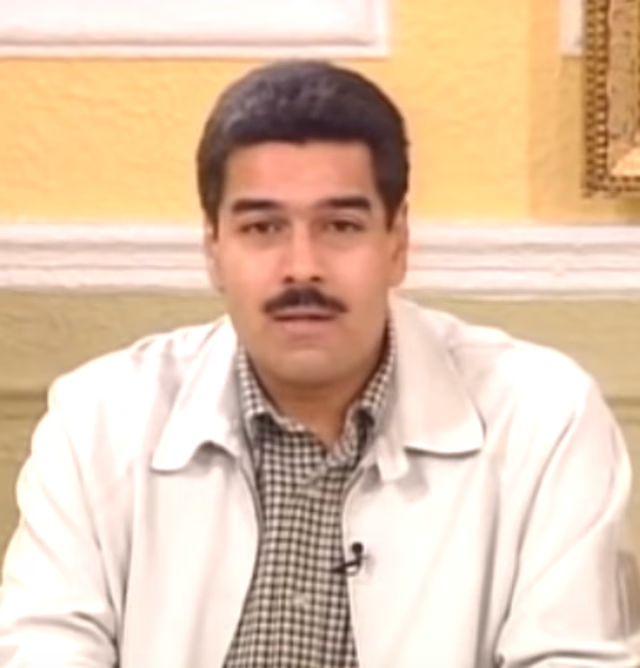
The capture of Nicolás Maduro in downtown Caracas and his transfer to U.S. custody marks more than the dramatic end of a brutal Latin American dictatorship. It signals the reassertion of American power in regions long ceded to adversaries—and for Israel, it represents a strategic inflection point with implications stretching from South America to the Middle East.
For years, Venezuela under Maduro functioned as a forward operating platform for America’s enemies. Closely aligned with Iran, Russia, and China, the regime facilitated sanctions evasion, intelligence cooperation, and, most ominously, Iranian-backed terror networks in the Western Hemisphere. This was not merely a regional problem; it was part of a global campaign to weaken U.S. influence and encircle Israel through proxies and partners hostile to the Jewish state.
President Trump’s decision to act decisively reverses a long period of American retreat. Across Latin America, pro-Western governments and civil societies had grown bitter at Washington’s absence as radical leftist regimes entrenched themselves with the backing of Moscow, Beijing, and Tehran. By removing Maduro, the United States has made clear that the hemisphere is not an open playground for hostile powers—and that alliances with Iran come with consequences.
That message is especially loud in Tehran.
Maduro’s capture came on the heels of unambiguous American warnings to Iran: the United States will not allow the Islamic Republic to rebuild its nuclear or ballistic missile capabilities, nor will it stand idly by as the regime crushes its own people. The sequencing matters. Iran’s leaders understand power, not communiqués. Watching a close ally fall—swiftly and publicly—underscores that American threats are no longer rhetorical.
For Israel, this is profoundly good news.
Israel’s security environment is shaped not only by its immediate borders but by the global reach of Iran and its network of allies. Every regime that facilitates Iranian financing, weapons transfers, or diplomatic cover strengthens the forces aligned against Israel. Conversely, every collapse of an Iranian partner weakens the axis that fuels Hezbollah, Hamas, and other terror organizations dedicated to Israel’s destruction.
Maduro’s fall thus reverberates far beyond Caracas. It raises the possibility of renewed deterrence—what earlier generations called Pax Americana—in regions where American resolve had been doubted. That deterrence is the indispensable foundation for any durable peace in the Middle East. Israel is safer when its enemies believe the United States will act.
Critically, this episode also clarifies a truth Israelis have long understood: Israel’s security depends less on warm words and more on credible power. A U.S. president willing to project force, challenge isolationism, and confront adversaries abroad ultimately does more for Israel’s survival than one who offers sympathy while shrinking from hard decisions. Strength deters war; weakness invites it.
Looking ahead, the removal of yet another virulently anti-Zionist dictator creates new diplomatic possibilities. A weakened Iranian alliance system could open space for stability with Lebanon and Syria, deepen normalization with Arab states, and even—however distant it may seem today—change the calculus inside Iran itself. History shows that when authoritarian regimes lose external support, internal pressure follows.
From Caracas to Tehran, the message is unmistakable: the era of unchecked Iranian expansion and American hesitation may be ending. For Israel, a nation that lives with the consequences of global power shifts every day, that change could be nothing short of historic.