
Sudan’s civil war is no longer a struggle contained within its borders. It is now a crucible where regional rivalries, technological escalation, and the ambitions of foreign powers converge — with devastating human consequences. The revelation of a covert Egyptian drone base deep in the Sahara is not simply a new wrinkle in Sudan’s catastrophic conflict. It is a sign that the war has entered an era defined by remote-controlled firepower, proxy entanglements, and a strategic calculus increasingly divorced from the needs of civilians.
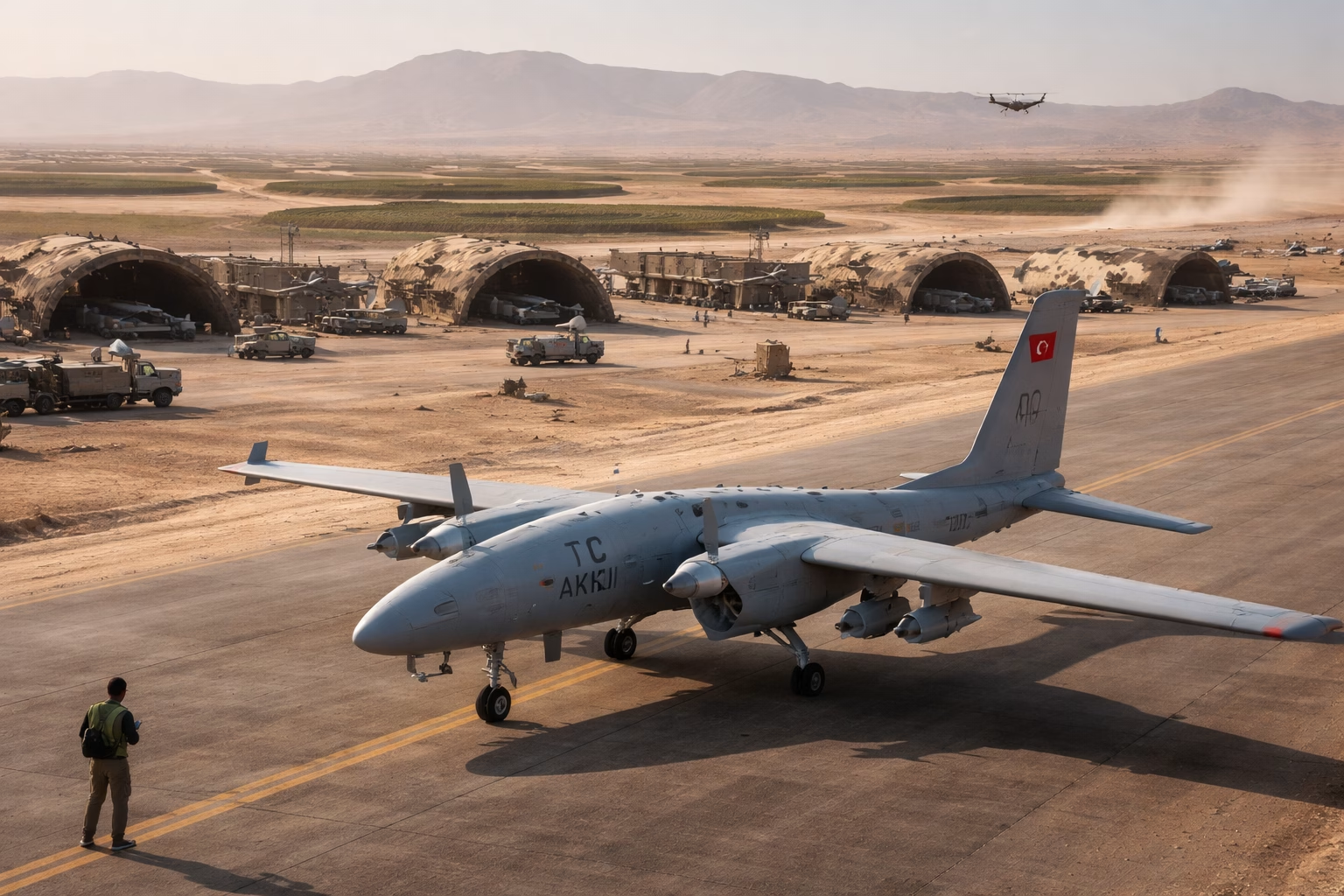
The war that has already displaced 12 million people and killed tens of thousands has become a proving ground for some of the world’s most sophisticated drone systems. But the entrance of Egypt — operating from a concealed airstrip nestled among giant irrigated crop circles in the East Oweinat desert — marks a turning point. Cairo has quietly shifted from diplomatic stakeholder to direct military actor.
And it did so the moment it feared the most: the collapse of El Fasher and the Rapid Support Forces’ march across Sudan.
Egypt’s Red Line
Egyptian President Abdel Fattah el-Sisi has long feared an R.S.F.-dominated Sudan. When the group seized El Fasher after an 18-month siege, that fear metastasized into action. More than a million Sudanese refugees had already crossed into Egypt. A hostile, heavily armed paramilitary entity controlling the Nile’s upstream neighbor was unacceptable.
Enter the drones.
Satellite-operated Baykar Akinci drones, Turkey’s most advanced platform, began striking deep inside Sudan — hitting R.S.F. convoys, border crossings, and supply lines coming from Libya and Chad. Their range — over 4,500 miles — made Egypt a viable launchpad. Their payload capacity — triple that of the Bayraktar TB2 — made them decisive.
This was not mere tactical support. It represented a strategic decision to reshape the war’s balance of power.
A War Conducted by Joysticks
Sudan has become a laboratory for high-tech proxy warfare. The R.S.F. receives Chinese CH-95 drones and jamming systems from the United Arab Emirates. The Sudanese military responds with Turkish drones, Russian ordnance, and Iranian equipment. Saudi Arabia and Qatar play their own roles. Libya provides a weapons corridor.
The battlefield is now surveilled, mapped, and struck from hundreds of miles away. Analysts pore over satellite imagery of convoys and destroyed villages. Operators — whether Egyptian, Sudanese, or Turkish — sit behind screens controlling machines that decide life or death.
This technological escalation has not made the war more precise. It has made it more indiscriminate.
R.S.F. drone strikes have hit kindergartens, killing 63 children. Power plants, water stations, and hospital roofs have been obliterated. The Sudanese military’s Turkish-supplied munitions have killed scores in “precision strikes” that often look anything but precise when viewed from the ground.
Drones do not reduce atrocities. They make them easier to commit at scale.
The Foreign Hands Steering Sudan’s Future
Egypt’s involvement is particularly delicate. Cairo relies heavily on Emirati investment — including billions poured into megaprojects. Yet the UAE backs the very paramilitary group Egypt is now bombing. Sudan’s war has thus exposed an uncomfortable truth: the region’s powers are willing to fund both sides of a conflict if doing so preserves influence.
This is not altruism. It is geopolitics.
Gold wealth from Sudan’s mines becomes ammunition. International sanctions slow nothing. Russian, Turkish, Emirati, Egyptian and Qatari interests crisscross the desert like flight paths. Even Russia’s Aviacon Zitotrans — sanctioned for arms smuggling — appears in flight logs tied to the Egyptian base.
Sudan is no longer fighting Sudan’s war.
A Conflict No One Can Win
Despite the influx of foreign drones, mercenaries, weapons systems, and money, neither the R.S.F. nor the Sudanese military is any closer to victory. Instead, the war has metastasized, with millions on the brink of famine and entire regions without electricity or clean water.
The tragedy is that each new drone strike — whether launched from Darfur, Port Sudan, or a hidden Saharan runway — pushes Sudan further from reconciliation and deeper into fragmentation. The foreign powers fueling the conflict are not solving Sudan’s crisis. They are prolonging it.
And in the desert, in a place so vast that astronauts once photographed its wheat circles from space, the future of Sudan is being shaped by machines launched far from the reach of the civilians they kill.
The Imperative the World Keeps Ignoring
Sudan is now the epicenter of the world’s most advanced proxy drone war. But high-tech tools do not produce political solutions. They entrench stalemates. They empower warlords. They hollow out states. And they condemn civilians — always civilians — to pay the highest price.
The longer foreign powers wage war by remote control, the further Sudan drifts from unity, stability, and peace.
If the international community does not force diplomatic accountability now — not abstract “monitoring,” but sustained, enforced engagement — the drones will continue to redraw Sudan’s map. And every redraw comes with a graveyard.
Sudan’s war will not be resolved from a control room in Egypt’s desert. It begins with diplomatic courage, regional responsibility, and a world finally willing to confront those who treat another nation’s tragedy as a battleground for their ambitions.