
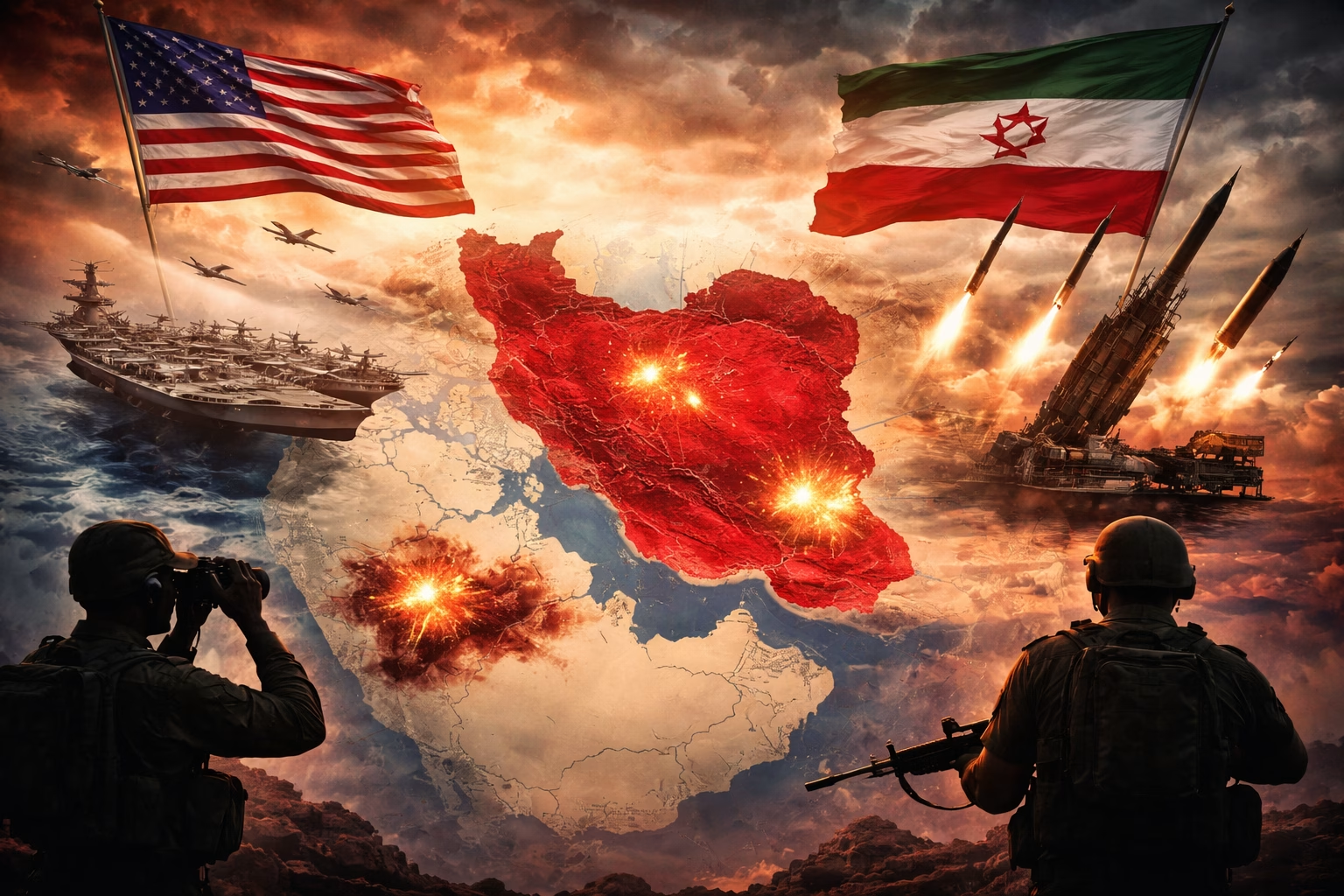
By any sober reading of recent intelligence assessments, the possibility that China may be escalating its military support to Iran is not just another geopolitical footnote—it is a warning flare. If reports that shoulder-fired missiles have been transferred prove true, it would mark a dangerous inflection point in an already volatile region, with direct implications for Israel’s security and the broader stability of the Middle East.
For decades, Beijing has perfected a strategy of plausible deniability. Rather than overtly flooding Iran with finished weapons—as it did during the Iran-Iraq War—China has leaned into “dual-use” exports: components, chemicals, and technologies that quietly enable Tehran’s missile and drone capabilities. This approach has allowed China to benefit economically and strategically while avoiding the full weight of international accountability.
But ambiguity is not neutrality. When Iranian-made drones strike Israeli targets or threaten civilian populations, the supply chains that made those systems possible matter. If Chinese components, navigation systems like BeiDou, or even direct weapons transfers are part of that chain, then Beijing is no longer a distant actor—it is an enabler of aggression.
Israel, for its part, has been on the front lines of this evolving threat. Iran’s military doctrine increasingly relies on asymmetric warfare: precision-guided missiles, drone swarms, and proxy militias. These are not theoretical dangers. They are operational realities faced by Israeli civilians and defense systems on a near-daily basis. The sophistication of these threats does not emerge in a vacuum. It is built, piece by piece, through international networks of technology and support.
What makes this moment especially concerning is the potential shift from covert assistance to more direct involvement. Even the suggestion that China might supply shoulder-fired missiles—portable systems capable of targeting aircraft—raises the stakes dramatically. Such weapons could alter tactical calculations not only for Israel but for any Western-aligned force operating in the region.
Critics may argue that China’s primary motivation is economic—that its dependence on Persian Gulf energy necessitates a relationship with Iran. But economic interest does not excuse strategic recklessness. In fact, it underscores the contradiction at the heart of Beijing’s policy: China seeks stability to secure its energy imports, yet its support for Iran contributes to the very instability it claims to avoid.
The United States, under Donald Trump, has signaled a willingness to respond forcefully, including through tariffs. Whether or not one agrees with that specific tool, the broader principle is sound: there must be consequences for actions that empower one of the world’s leading state sponsors of terrorism.
For Israel, this is not merely a diplomatic issue—it is existential. The Jewish state cannot afford to ignore the gradual tightening of a strategic axis that includes Tehran and potentially Beijing. Nor should the international community. A world in which major powers quietly arm revisionist regimes is a world inching closer to wider conflict.
The path forward requires clarity and resolve. Intelligence must be rigorously verified, but hesitation cannot become paralysis. If China is indeed crossing a new threshold in its support for Iran, then the response must be equally decisive—economically, diplomatically, and strategically.
Because in the Middle East, the distance between a “component” and a catastrophe is often shorter than the world is willing to admit.