
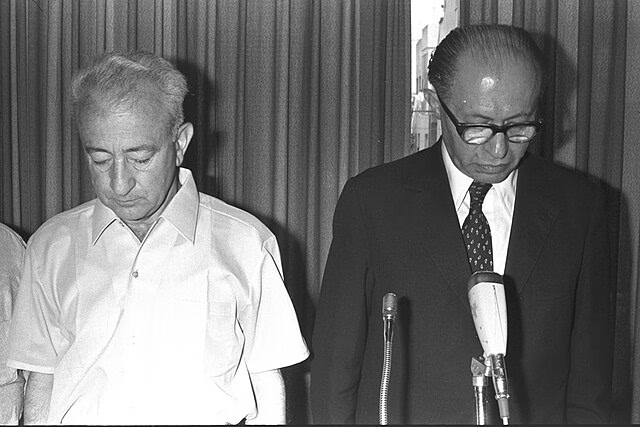
‘Whatever his attire, his clothes are never neat, and his hair is never combed. He is very sloppy in this regard’: An investigation issued by the Haganah’s intelligence service offers a peek into how the Irgun underground commander was perceived before becoming Israel’s Prime Minister
May 19, 2025 12:46 pm IDT
The description of the commander of Israel’s pre-independence Irgun underground, Menachem Begin, that was issued by the Haganah’s intelligence service wasn’t particularly flattering.
“He walks hunched over, his shoulders pulled forward, his arms are very long and, looking at him, one gets the impression that he doesn’t know what to do with them,” a 1945 report stated.
“He excels mainly in having an irregular gait. He drags his feet (a ‘Jewish’ gait) and often trips over himself. He wears very large shoes, and the structure of his feet is abnormal,” it says. “Every few minutes, the man makes a thin coughing sound, particularly while walking. Whatever his attire, his clothes are never neat, and his hair is never combed. He is very sloppy in this regard.”
The document, written some 80 years ago, was recently made public by the Israel State Archives, selected from a file of hundreds of pages regarding the Haganah’s surveillance of Begin, who would later become prime minister. Members of the public now have access to it thanks to Elad Man, the legal adviser to the nonprofit group Hatzlacha, which works to provide public access to information of public interest.
Open gallery view

A document issued in 1945 by the Palestine Police Force offering a reward for anyone giving information which would lead to the apprehension of Begin.Credit: The State Archives
Open gallery view

Then-Prime Minister Menachem Begin give a speech at an event in the Isareli city Ariel, located in the Occupied Territories, in 1981.Credit: Yaakov Saar / GPO
In early 2024, after reviewing the papers, a portion of which were made available to the public as the “Menachem Begin File,” Man was surprised to discover that large portions had been entirely censored. He asked the Israel State Archives to reexamine the justification for that and, as a result, most of the censorship restrictions were lifted.
Back in 1945, Begin had gone underground for fear of being arrested by the British, whose rule over Palestine his Irgun fighters opposed. Along with the British authorities, the Haganah – the larger pre-independence underground army of the Jewish community that later constituted the core of the Israeli army – also monitored his movements due to his armed activities.
Apart from the many reports that deal with the Altalena affair, one document that was allowed to be made public says Begin admitted that his organization planned to seize portions of the country.
The 1945 report included other “compliments,” such as “his face is very long and his chin is especially long and sharp. Through his glasses, his eyes are like those of a calf, and his gaze gives a dark and stupid impression. His nose is long and ends like his chin, sharply. Its shape is that of an eagle’s nose.” The description also notes that “when he smiles, a considerable gap is revealed between the two upper middle teeth, filled with saliva.”
The report doesn’t make do with a physical description. “And as for his character, he’s usually cowardly and craven. But at the same time, he has unusual audacity,” it stated. “He’s capable of interrupting even a famous speaker and won’t settle down until he’s taken out of the hall. He may give the impression of being a brave man when he feels that some kind of force is behind him, but as soon as the support disappears, he behaves like a mouse.”
Open gallery view

People watch the Altalena on fire from the Tel Aviv shore, in June 1948.Credit: GPO
Concerns – whether real or imagined – regarding Begin’s political and military activities appear in many of Haganah documents from the 1940s, from the early years of the decade until a few months after Israel’s establishment in May of 1948.
Understanding those concerns requires knowledge of the agreement signed by the Irgun and the Defense Ministry of the new State of Israel on June 1, 1948. It states that Irgun fighters would be enlisted into the Israel Defense Forces and that their weapons, equipment and manufacturing facilities would be handed over to the army. In addition, the Irgun was prohibited from arming itself with new weapons.
The documents in the file show that the Haganah had received reports that the Irgun was systematically violating the agreement, violations that culminated in the incident involving the ship the Altalena. At the beginning of June 1948, a short time before the Irgun ship was sunk off the Tel Aviv shore, the Haganah issued a report on the future of the Irgun that predicted that the underground would no longer participate in combat but that the Herut party, which was led by Begin and would eventually become today’s ruling Likud party, “would establish contacts with extreme right-wing circles in the Jewish community and offer its help against the left.” It added that “an armed militia would be established alongside the party.”
According to a report in the file, on June 15 of that year, 400 Irgun fighters equipped with rifles, Sten guns and armored vehicles paraded through Be’er Yaakov, south of the Tel Aviv area. “The commander turned over command of the parade to Begin, who appeared dressed in a gray suit with white stripes, white shirt and tie and sunglasses,” it said. Another Haganah report from the period states that Begin ordered Irgun fighters based in Jerusalem to be equipped with new weapons.
Open gallery view

A document written in 1947 referring to Begin’s appearance, his attire and where the places he visits.Credit: The State Archive
“Begin gave urgent orders to buy weapons in Haifa for transfer to Jerusalem. … In recent days, quantities of arms were moved to Jerusalem,” the report alleges. According to another item in the file, at a meeting purportedly convened before the Altalena’s arrival, Begin said serious things about the underground’s plans.
“The meeting discussed the arrival of the arms ship to Israel. Begin also noted that members of a government that the Irgun was about to establish were about to arrive in Israel on this ship …. Begin noted in his remarks that upon seizing power, the Irgun would take action against the left and the Reds,” the report states.
The arrival of the Altalena ended in tragedy. Sixteen Irgun fighters and three IDF soldiers were killed in an exchange of fire when the army tried to prevent the Irgun from unloading weapons from the ship and demanded that they be handed over to the IDF.
He wants to be a dictator
Begin was born in Brisk, now the city of Brest in Belarus, in 1913. At a young age, he joined Betar, the youth movement of the Revisionist party. He later studied law and in 1939 was named head of the movement in Poland. With the outbreak of World War II, Begin fled east. He was eventually drafted into the free Polish army headed by Gen. Władysław Anders and eventually reached Palestine in 1942 with the army.
A Haganah document from that year reported that Begin worked in the Polish army’s offices in Jerusalem and was “very concerned that his work in the Irgun would become known in the army.” At the end of 1943, after being released from military service, he was appointed Irgun commander and a few months later announced the resumption of the revolt against British rule.
Open gallery view

Begin visit the Palestinian village of Sebastia in 1974.Credit: Yaakov Saar / GPO
Apart from the many reports that deal with the Altalena affair, one document that was allowed to be made public says Begin admitted that his organization planned to seize portions of the country. The report includes a summary of a meeting that purportedly took place on June 30, 1948 between Begin and his regional commanders.
“Begin glossed over the failure of the ship affair,” it read. “Begin said that if 5,000 Irgun soldiers had been properly equipped, the Irgun would have seized a stretch of land and defended it against any attacker – whether Jewish or Arab – but because it was poorly armed, it was necessary to make concessions.”
The file includes a report on a meeting of the Irgun command in Tel Aviv after the Altalena incident. Begin reported to his followers that weapons had been given to the army but also said that some arms were given to Irgun fighters in Jerusalem. Under the United Nations Partition Resolution of 1947, Jerusalem was to remain an international zone and not part of the State of Israel. Therefore, the Irgun operated there as a separate unit.
“Begin informed the government of the delivery of a quantity of weapons to the army …. Begin reported that large quantities of weapons, sufficient to fully equip a battalion and a half, had already arrived in Jerusalem,” it said.
Open gallery view

The remains of the Altalena seen from the Tel Aviv shore.Credit: GPO
The Haganah also monitored extreme statements by senior figures in Begin’s entourage, including one at a meeting that allegedly took place at a restaurant in Petah Tikva attended by underground commanders. According to the report, one person in attendance “became resentful of Begin for believing too much in state institutions” and then “suggested inciting a civil war and taking up arms in the event of failure in the upcoming elections.”
Another document reported that Haim Landau, an Irgun commander who later became a Knesset lawmaker and Likud cabinet minister, told a meeting of the organization that “we will need to take power whatever the price ….”
The Haganah also received reports of meetings and events that Begin attended. In August 1948, for example, he gave a speech to Irgun commanders in Jerusalem.
“We need to establish the best battalion in the world in Jerusalem. They need to continue their training day and night to attain the proper level. There is no doubt that we will reach it. In the future, major positions will be assigned to us, and we must perform them successfully,” he said according to the report.
“Pay no attention to minor problems with living conditions,” he reportedly told his audience. “I myself have lived in worse conditions than yours and didn’t die. I visited the battalion kitchen and just by the smell, I could tell that the food is good. You won’t die from it …. I would gladly take off my [necktie] and join your ranks, but those in charge of me are preventing me from doing so. I too have a certain role to play, which must be performed despite the difficulties.”
Open gallery view

The summary of a meeting which took place in June 1948 beteen Begin and the districts commanders of the Irgun.Credit: The State Archive
The report ends with an anecdote: “Menachem Begin made a fool of himself when he saw someone taking his picture. He jumped off the stage and shouted: ‘Photograph me among the soldiers.'”
The negative attitude toward the Irgun is also reflected in another report, which states that “in the right-wing camp,” there was “a measure of disappointment” following a speech by Begin that was said to “lack a clear political line beyond outpourings of emotion and threats.”
Another of his speeches was said to be “a lecture mostly consisting of slogans and phrases …. The applause wasn’t very enthusiastic …. There were moments when fatigue made some of the people leave.”
Many other documents in the file detail the surveillance over Begin while he was living under a false identity. A 1946 report entitled “Suspect location in Tel Aviv” states that “one of our men who happened to be in Tel Aviv” provided the Haganah with intelligence based on a conversation that he had “overheard.” According to the report, “In the vicinity of Metzudat Ze’ev [today the Likud’s headquarters] and Gan Meir, there is a place on the second floor of a house for Torah study. Old men study there, one of whom has a gray beard. One of the interlocutors noted that whenever someone approached the place, they would start studying there loudly. The gray-bearded man, it was said, was Menachem Begin, and that was his meeting place.”
Another document in the file stated: “Mrs. Disenchik [apparently Shlomit, the wife of Arie Disenchik, a Betar activist and later editor of the Maariv daily] says that recently Menachem Begin has often been visiting her apartment. They hold meetings there. We know the house well. For a long time, we’ve believed that Begin was visiting very frequently. You know the address.” Other reports provide details of a car that Begin was using, including the model, the license plate number and driver’s name.
Open gallery view

A report surveillaning Begin in 1946, when he worked underground and used aliases.Credit: The State Archive
The report also notes that Begin was a new immigrant at the time, having arrived from Poland three years earlier. “He often uses expressions that aren’t common in the country,” it states, providing examples of very formal Hebrew, such as the use of “anochi” instead of “ani” for the pronoun I. “His accent is Polish.” Begin has a musical bent and “likes Betar songs, tango, Soviet songs and songs of the Polish army,” it was reported.
One point in his favor was that “his wife is very devoted to him, and he madly loves his child.” An earlier document from 1942 noted that he had “bad teeth, a long, crooked nose.” The police were “looking for him” and would also offer a reward for information on his whereabouts. The second page of the document states that Begin “declared that he wanted to be a dictator.”
Sections of the file remain censored and on pages that have been released, details such as the names of the entities and individuals involved in writing the reports have been blackened out. Next to censored passages, there is a notation that for reasons of state security, the full document would only be available 90 years after its compilation – meaning in 2038.
Elad Man, the Hatzlacha organization’s legal counsel, said that many files in the state archives remain censored for no reason.
“The blackened out passages in archive files shouldn’t be accepted as a fait accompli. Sometimes they’re made without justification in a sweeping manner and without exercising appropriate discretion,” he said. “Persistence pays off and reveals valuable information to the public that wouldn’t have been disclosed otherwise.”