
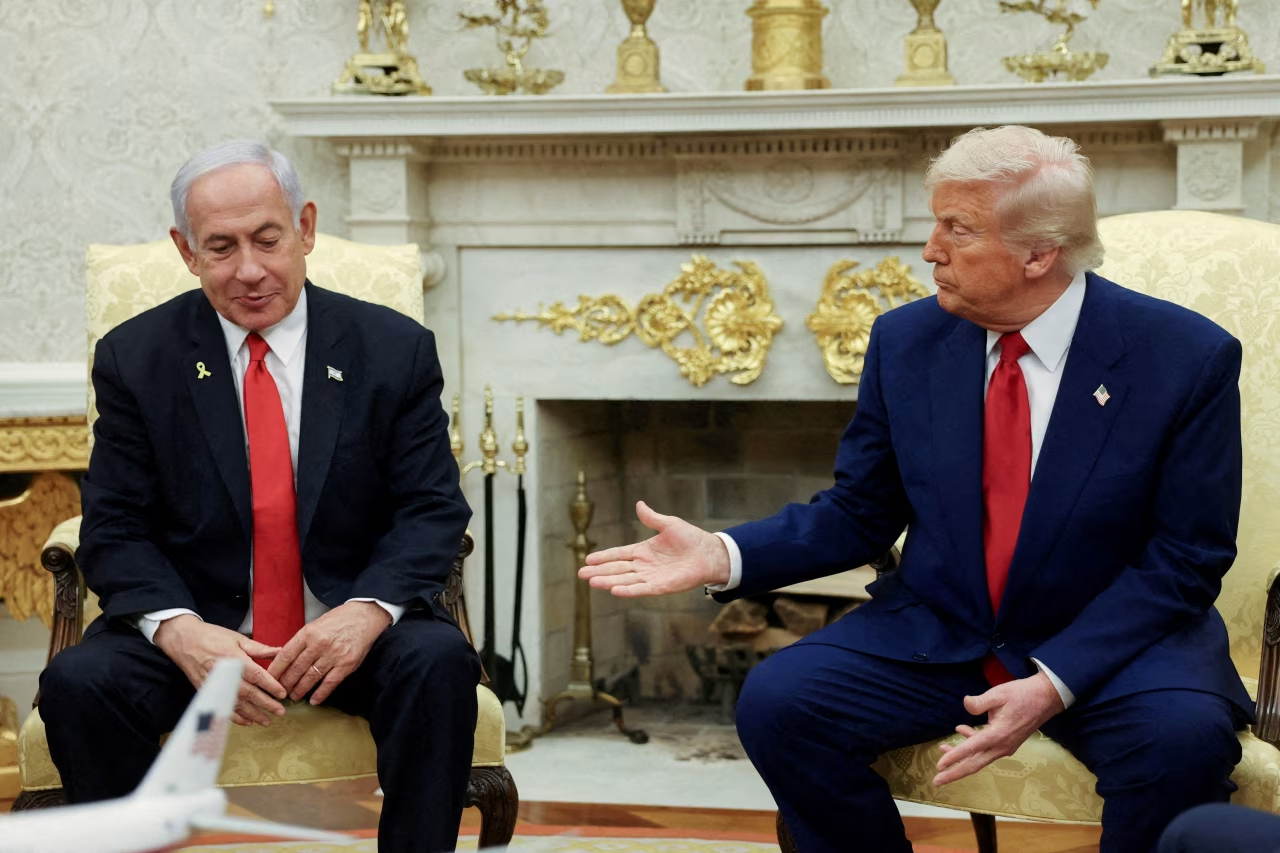
He will act unilaterally to advance American interests, and Jerusalem is free to do the same.
The Trump administration has taken a series of foreign-policy steps in recent weeks that are quietly reshaping the U.S.-Israel relationship. The moves acknowledge that the two countries’ interests overlap in many ways but aren’t identical.
The U.S. brokered a cease-fire with the Houthis even as they continued firing missiles at Israel. Washington dropped its longstanding condition that Saudi Arabia normalize relations with Israel in exchange for a civilian nuclear deal—long seen as the linchpin of the next round of Abraham Accords. It has held nuclear talks with Iran and lifted sanctions on Syria, over the objections of Israeli leaders. Most notably, the U.S. secured the release of American-Israeli hostage Edan Alexander without including Israel in the negotiations.
Taken together, these decisions suggest a shift: The U.S. is pursuing its regional interests independently. Rather than offering rhetorical support while simultaneously demanding restraint, the Trump administration appears to be acting on its own priorities, and Israel is free to do the same.
Mr. Trump’s ambition is coming into focus: He wants to reconfigure the region’s balance of power. To achieve this, he appears to be investing in stronger ties with regional actors such as Qatar and Syria to pull them away from Iran’s orbit. Drawing adversaries away from Tehran is less costly in both blood and treasure than confronting Iran head-on.
For Israel, this new U.S. posture offers both opportunity and risk. It reinforces the country’s conviction that it must be able to defend itself by itself.
Since the Oct. 7, 2023, attacks, that principle has been tested repeatedly. The Biden administration often expressed support for Israel while simultaneously applying pressure—urging restraint, pausing arms shipments, and setting conditions on military operations, such as opposing an offensive in Rafah. Too often, this limited Israel’s ability to act on its own assessments.
The Trump administration has taken a different tack. Mr. Alexander’s release, for instance, was negotiated without Israeli input—but also without demands that Israel pause its military campaign to facilitate it. That may reflect a broader willingness to act unilaterally and let Israel do the same.
Some may worry this dynamic leaves Israel vulnerable, that it is being relegated to the margins while Washington cuts deals in the region. That concern is valid. But it’s also worth asking if Mr. Trump’s model is more honest than a relationship based on symbolic gestures and behind-the-scenes friction—a new model that lets both nations act on their interests without pretending perfect alignment.
Still, the U.S. and Israel can’t afford to drift far apart. The security of both nations is linked. Iran doesn’t view Israel as its final adversary, but rather as a stepping stone toward confronting the West.
Instability in the Middle East never stays in the Middle East. A stable region isn’t only in Israel’s interest—it’s in America’s, too.
We may be entering a new phase in the U.S.-Israel relationship. One with fewer promises, fewer pretexts, and fewer illusions. Real partnership isn’t built on being in perfect sync—it’s built on candor, and the confidence to stand side-by-side without always pretending to stand as one.
Ms. Klompas is a co-founder of Boundless Israel and co-host of the Boundless Insights podcast.