
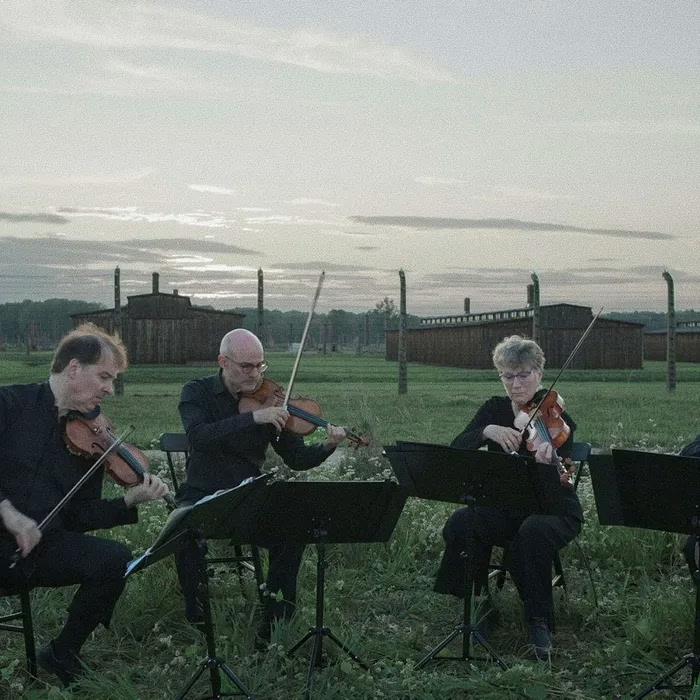
David Lynch may not be the most obvious inspiration for a film about music at the Nazis’ most notorious death camp, but that’s just one of the many surprises in Toby Trackman’s new documentary “The Last Musician of Auschwitz.”
The Bristol-born director, 46, has spent a career pursuing his two passions of film and music, most recently in the four-part Hulu documentary “Camden,” which explores the legendary north London suburb that was once home to both Britpop and Amy Winehouse.
“I Was Very Wary of Opening That Box”
When we spoke in a video interview last week, Toby had just returned from California, where he was “filming musical royalty” for his latest project. Carole King? Your guess is as good as mine.
His passions dovetail to stunning effect in his moving new documentary, which reveals the most noteworthy music created by prisoners at Auschwitz-Birkenau. The film also highlights the often surreal and cruel role music played at the camp. As one of its participants puts it, “Music was played to the most terrible things.”
As for the part played by Lynch? “There’s an episode in the third season of ‘Twin Peaks,’ which is a 20-minute wordless sequence about the explosion of an atomic bomb,” Trackman explains. “There was something about the intensity and feeling of that scene that I carried with me the whole way through making the film.”
Other left-field inspirations for a documentary that is as much driven by sounds as it is by sights? Berlin’s Memorial to the Murdered Jews of Europe (“The pillars all seem fairly regimented, but when you get into it, the floor is at an angle and you’re quickly thrown off balance and disconcerted,” the Jewish filmmaker says), and a British arts collective called United Visual Artists whose work – including with Bristol group Massive Attack – involves “light and sound and space.”
Yet for a documentary that serves as the perfect summation of his 15-year career, Trackman admits it took some persuasion to convince him to make “Last Musician.”
“In all honesty, when the project first came to me, I was very hesitant to take it on,” says the Brit, who describes himself as culturally rather than religiously Jewish. “I was very wary of opening that [Holocaust] box and stepping into it, knowing that I would have to live in that world personally for a very long time.”
What ultimately convinced him, after several months of conversations, was the realization that he wanted to “safeguard” a sacred story. “I realized that I didn’t want somebody else to do it. I felt that there was a sort of responsibility here.”
Trackman “lost a branch” of his Polish family during the war, but none in Auschwitz itself. Indeed, prior to filming there, he had never visited the site near the Polish town of Oświęcim where 1.1 million people – including nearly 1 million Jews – perished between 1940 and 1945.

Director Toby Trackman during the shooting of The Last Musician of Auschwitz. “I had a camera to hide behind, I had a job to do, and that sort of gives you a shield.”Credit: Cosmic Cat Films
He would go on to make numerous visits during production, but his first trip took place without the presence of a single camera, for what he calls an “emotional recce.”
“Obviously, the first time you visit is incredibly powerful – we had, essentially, a private tour with the amazing guides there. But I never had the visceral, emotional, physical reaction that I was afraid of at the beginning, because I went into it knowing that this was going to be the first visit of many.
“Even back then,” he adds, “I knew I had to work out a way of not being overwhelmed so that I could function. And then on subsequent visits I had a camera to hide behind, I had a job to do, and that sort of gives you a shield.”
“Scared Stiff” to Play the Wrong Notes
The title “The Last Musician of Auschwitz” may be slightly misleading, as it’s not about a single individual but rather several distinct talents, pared down from an original list of about 80 possible musicians who were housed at the death camp. These include Polish composer Szymon Laks, Czech songwriter and night nurse Ilse Weber, Polish conductor Adam Kopyciński and German cellist Anita Lasker-Wallfisch (who gives the film its title).
The latter was also seen on our screens last year in another powerful documentary, “The Commandant’s Shadow,” where she recalled her experiences at Auschwitz under Nazi commander Rudolf Höss. The straight-talking 99-year-old is again a towering presence in Trackman’s film, this time discussing her experiences playing in several of the camp’s 15 orchestras.
“We were scared stiff to play wrong notes,” Lasker-Wallfisch says in the film about entertaining relaxing SS officers, or playing marches at the camp entrance every morning and evening as prisoners set off on their day’s work, often never to return.

German cellist Anita Lasker-Wallfisch, who gave the film its title. “We were scared stiff to play wrong notes,” she recalls in the film.Credit: Cosmic Cat Films
The actual music is another of the documentary’s surprises. Alongside more predictably somber pieces such as Laks’ “Funerals” and Rosebery d’Arguto’s heartrending “Jewish Death Song” are some startlingly upbeat pieces. There are also subversive tunes containing Jewish or Polish melodies, hidden under the ears of captors who insisted only on German music.
Holocaust music historian Francesco Lotoro sums it up most memorably when noting in the film: “This music doesn’t belong to the past. This music belongs to the future.”
Trackman acknowledges that people approaching “Holocaust music” may imagine that they already know what it’s going to sound like. They could be wrong.
“What’s interesting is that when I started looking into it, a lot of the pieces of music that we associate with that time period are actually written later – from the 1950s onward,” he explains.
“It was a real surprise to look at the pieces that were actually written at the time. They were all surprisingly cheerful, because that’s what music was like at that point. By and large, the darker side [at Auschwitz] hadn’t actually happened yet – and that was quite a difficult thing to square with the film.
“We all felt from the beginning,” he adds, “that it was very important to try and show in the exploration of the different modes of music that there was an element of resistance and an element of hope – or that people were using music to give them some kind of emotional salve.
“There are mixed opinions in the film from the people who experienced it as to whether or not music was actually of help. But the fact that some people said it was is enough to make us validate the idea that it was some form of emotional support. And that was the other thing: Trying to work out, as a filmmaker and as a Jewish person, how you tell that story without injecting a false sense of hope for the audience, just to feel a bit better about things.
“But at the same, you need to give the ups and downs emotionally – it can’t just be this monotone of fear and despair. So, all these things were running through our heads as we were looking for the music.”

Holocaust music historian Francesco Lotoro. “This music doesn’t belong to the past. This music belongs to the future.”Credit: Cosmic Cat Films
Auschwitz’s 1.3 million prisoners also included members of the LGBTQ+ community, the disabled, political prisoners and members of the Romani/Sinta community – something the film makes sure to address. In fact, one of the film’s most memorable moments comes when musicologist Petra Gelbart, the granddaughter of a Romani Holocaust survivor, sings the haunting Romani song “There’s a Big Building in Auschwitz.”
Music as a Character
With the aid of musical arranger and composer Jessica Dannheisser, Trackman stages all the musical performances both evocatively and sensitively. For him, this was a key element in giving the film its power.
“It was a really creatively exciting prospect to be able to use music as a character in and of itself in the film, and to use it in a storytelling way,” he says. “What I always wanted to avoid was the idea that we just stop and then there’s a performance. That would be very moving, but it would essentially be a pause in the film.
“I really wanted that when you get to one of these pieces of music, that it’s rounding off and solidifying the emotions that have just led you to that point,” he explains. “Often I find that viewers have the biggest emotional reactions then – and I think that was because we worked very, very hard to position them in the film and give them a real sense of purpose.”
Trackman also believes his years spent working on documentaries about people in “incredibly raw, traumatic situations” – previous works include “Stabbed: Britain’s Knife Crime Crisis” and “Sarah Payne: The Untold Story,” about a murdered 8-year-old girl – helped him build a relationship of trust with the guardians at Auschwitz. Having Lasker-Wallfisch on board also helped, he says.

Director Toby Trackman, left, with a quartet outside Auschwitz-Birkenau. “This was the music embedded in the concrete and walls of the camp…. we were clawing fragments of that back.”Credit: Cosmic Cat Films
Even so, filming at what is now a memorial site, visited by over 1.8 million people in 2024 alone, came with a strict set of rules.
“There are very clear boundaries about what you can and can’t do,” the director says. “For instance, we had to make sure it’s very clear that the performances were all obviously staged outside the perimeter of the camp – because no one is allowed to do music inside the perimeter. But with their help, we got as close to the camp as you possibly could. And I think that proved to be very special.”
Equally haunting is the music written especially for the film by Dannheisser – who, unusually, accompanied the director throughout the shoot. “I’d always talked about the idea that the music we were going to compose for the film was related to this lost music of the camp,” the director says. “That this was the music embedded in the concrete and walls of the camp, and we were clawing fragments of that back and scraping that from the walls.”
Today, despite his initial fears, Trackman is clearly proud of the completed film and the fact that it’s receiving a British cinematic release, five months after airing on the BBC for International Holocaust Remembrance Day. He urges viewers who may have already seen the film on television to give it another look on the big screen. Or, more accurately, another hearing.
“I think the experience of hearing it in surround sound in a cinema, hearing those incredible performances and that incredible soundtrack wash over you – it really transports you,” he concludes.