
Part III Alex Grobman PhD
Historian Isaiah Friedman said that at the end of the 19th century, Palestine was a small area far from the heart of Europe but governed by the consulates of Britain, the United States, France, Prussia, Sardinia, Austria, Spain and Russia. Increased immigration from Europe by Ashkenazic Jews changed Muslim-Jewish relations as European powers intervened to protect their citizens from Turkish or Arab persecution under capitulation agreements negotiated with the Ottoman Empire.
Ruth Kark, a professor of geography, said the consul’s extraterritorial rights meant that he had ultimate power over the assets and lives of the nationals residing within the territorial boundaries of his command. Each consulate even had its own prison room. In turn, historian Yosef Gorney notes, the capitulation agreements permitted the Great Powers to increase their political presence in Palestine and “institutionalize” their missionary work. The protection reluctantly won the Jews respect from the Arabs, while also stirring resentment against them.
In the early 1850s, 5,000 Ashkenazim were under the protection of foreign consuls: 3,000 by Austria, 1,000 by the British, and the rest were registered with the American, Prussian, Dutch and Russian consulates, according to Friedman. By championing the rights of foreign Jews and endorsing Jewish resettlement in Palestine, Freidman said, the British established and expanded their consulate in Palestine, which they hoped to use to counter Russia’s expanding influence in the Levant.
Albert M. Hyamson, who served as chief immigration officer in the British Mandate of Palestine (1921-1934), said the British also took a special interest in the welfare of the Jews because as The Times of London noted “… no people on the face of the earth has been so little understood and so grossly misinterpreted as the Jewish… A new era is, however, commencing.”
Until war broke out in 1914, the British consulate in Jerusalem served as the place where every Jew in Palestine, no matter their nationality, could receive advice and protection. Hymanson said that when William T. Young began his work as vice-consul in 1838, his first dispatch instructed him to protect the Jews in Palestine and report on their present condition.
German historian Alexander Schölch said that Protestant missionaries in Palestine, also protected by the British, made common cause with the Jews as they were passionate believers in the “restoration of the Jews” to the Holy Land. Restoration gained worldwide interest in the 19th century as Protestants from around the world initiated projects to bring Jews to Palestine. Rather than convert the Jews, they sought to repatriate them to Palestine, which they believed would hasten the return of the Messiah. This movement further strengthened the bond between the British and Palestine.
In a May 25, 1839 letter to Viscount Palmerston, found in the National British Archives, British State Secretary for Foreign Affairs, Young, explained the situation of the Jews in the city. Although they enjoy “more peace and tranquility,” than ever before, “scarcely a day passes,” that he does not hear “of some act of tyranny and oppression against a Jew—chiefly by [Turkish] soldiers, who enter their Houses and borrow whatever they require without asking any permission—sometimes they return the article, but more frequently not.”
Young described the behavior of the Turkish Governor toward the Jews as “savage” after hearing an account of how his punishment of an innocent Jew led to the Jew’s death. He thought the governor was “superior to such wanton inhumanity—but it was a Jew without friends or protection…”
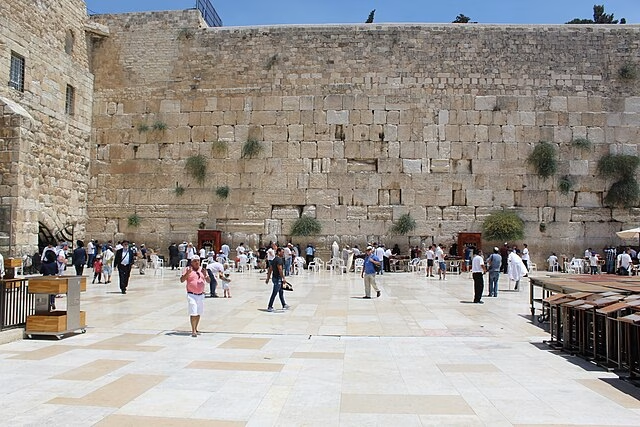
In “Stirring Times: Or Records from Jerusalem Consular Chronicles of 1853 to 1856,” James Finn, the British consul in Jerusalem, observed how local Muslims forced Jews to pay taxes to enable them to pray at their holy sites. For the privilege of praying at the Western Wall, for example, Jews had to provide a yearly payment to the Effendi, whose house was next to the Wall; the villagers of Siloam were paid a stipend for not vandalizing the graves on the slopes of the Mount of Olives; the Ta’amra Arabs were bribed so they would not damage Rachel’s Tomb near Bethlehem; and Sheikh Abu Gosh received money each year for “not molesting” travelers on the road to Jaffa, even though he received a significant sum yearly from the Turkish government as “warden of the road.”
With regard to Christians, Young reported: “If a Jew…were to attempt to pass the door of the Church of the Holy Sepulchre, it would in all probability cost him his life—this is not very Christian like, considering Christ Himself was a Jew. And were a Jew to fly for safety, he would seek it sooner in a Mussulman’s house than in that of a Christian. … In other words, the prejudice of Christians against Jews borders on fanaticism.”
Young added: “What the Jew has to endure, at all hands, is not to be told. Like the miserable dog without an owner he is kicked by one because he crosses his path, and cuffed by another because he cried out—to seek redress he is afraid, lest it bring worse upon him; he thinks it better to endure than to live in the expectation of his complaint being revenged upon him. Brought up from infancy to look upon his civil disabilities everywhere as a mark of degradation, his heart becomes the cradle of fear and suspicion—he finds he is trusted by none—and therefore he lives himself without confidence in any.”
“Until the English Consulate was established in Jerusalem,” asserted James Finn, “there was no other jurisprudence in the country than that of the old-fashioned corruption and self-will of the Mohammedans, and for many ages but very few (often none) of the European Jews ventured to make an abode in Palestine.”
British historian Tudor Parfitt said the relationship between the local churches and the Jews was described by H.H. Jessup, a leading personality in the American Presbyterian church in Beirut: “They are hated intensely by all sects, but more especially by the Greeks and the Latins. In the gradations of Oriental cursing, it is tolerably reasonable to call a man a donkey, somewhat more severe to call him a dog, contemptuous to call him a swine, but withering to the last degree to call him a Jew. The animosity of the nominal Christian sects against the Jews is most relentless and unreasoning.”
Historian Neville J. Mandel found that local Christian attitudes toward Jews provided fertile ground for European antisemitism. The Russian Imperial Orthodox Palestine Society, which began operating in 1882, barred Jews from their medical clinics, reflecting the negative views of the Tsarist government in Russia. All other segments of the local population were admitted.
Another source of anti-Jewish sentiment emanated from members of the consular corps, Mandel asserted, especially those from the Austrian and Russian consulates. Economic competition concerned the Deutsches Palastina Bank, Credit Lyonnais and other foreign banks and merchants. The thousand or so Protestants (“Templars”) from Germany who lived in Palestine shared this fear and the possibility that they might be included in the restraints placed on the Jews. In 1890, Jerusalem already had a German antisemitic club.
Mandel adds that in 1897, Père Henri Lammens, a Belgian scholar who taught at the Jesuit University in Beirut, wrote an article entitled “Zionism and the Jewish Colonies,” in the anti-Jewish and anti-Zionist Jesuit journal Etudes. Lammens described the Jews of Jerusalem as easily “recognizable … by their repulsive grubbiness and above all that famous Semitic nose, which is not, like the Greek nose, a pure myth.”
Dr. Alex Grobman is the senior resident scholar at the John C. Danforth Society, a member of the Council of Scholars for Peace in the Middle East and on the advisory board of the National Christian Leadership Conference of Israel (NCLCI). He has an MA and PhD in contemporary Jewish history from The Hebrew University of Jerusalem.