
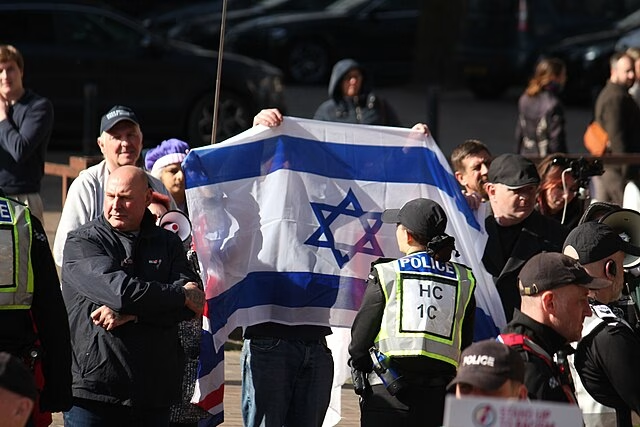
The playing field, once a rare sanctuary from the world’s political strife, is increasingly being redrawn along ideological lines. From blocked tickets in Birmingham to the exclusion of the Israel–Premier Tech cycling team in Italy, sport—the global language of unity—is being hijacked by selective outrage and double standards.
For decades, the spirit of international competition has been simple and profound: athletes meet as equals, representing not the politics of their leaders but the aspirations of their people. Yet as calls mount to ostracize Israel, that spirit is being eroded. What was once a platform for peace and coexistence is now being used to isolate a democracy fighting for its survival.
In recent months, Israel’s participation in global sport has come under open attack. Fans of Maccabi Tel Aviv were barred from attending a football match in Birmingham, following threats and political pressure from local officials who claimed they could not guarantee Jewish fans’ safety. In Italy, the pro-Israel Israel–Premier Tech cycling team was disinvited from a major event after protests drowned out any sense of fairness or neutrality. These incidents are not isolated—they are symptoms of a broader campaign to turn athletic arenas into stages for political intimidation.
The irony is inescapable. Nations with appalling human-rights records—among them Iran and North Korea—continue to compete freely in global sporting events. Russia, whose invasion of Ukraine provoked justified sanctions, at least faces restrictions for clear acts of aggression. But Israel, a democratic state facing an onslaught from terrorist groups that target its civilians, is being compared to aggressors and pariahs. The equivalence is not only false—it is morally perverse.
Sport has always thrived on the belief that human connection can transcend conflict. In 2008 and 2011, a team representing the Shimon Peres Peace Center brought together Israelis, Palestinians, and Australians to compete in Australian rules football. It was a living testament to how sport can bridge divides, even between sworn enemies. That example now feels distant, as the global conversation shifts from cooperation to cancellation.
Western governments, particularly in Europe, have shown little appetite to confront the mob. Political leaders issue statements condemning antisemitism even as they remain silent when Jewish teams and fans are targeted. In the UK, the decision to bar Israeli supporters under the guise of safety was effectively a capitulation to intimidation. When threats dictate policy, democracy gives way to fear.
If the world insists on mixing politics and sport, consistency is the least it should demand. Where are the boycotts of Iran, whose regime executes dissidents, funds terror across the Middle East, and denies women basic rights? Why do protesters turn their fury toward Israeli cyclists but ignore China’s abuses in Xinjiang? Selective outrage reveals not moral clarity but moral confusion—and, too often, latent antisemitism.
Israel’s response so far has been measured, even restrained. Quiet diplomacy can play its role, but the moment calls for something louder: a coordinated global campaign to expose these double standards. The same voices that denounce discrimination in every other context should not remain silent when Jews and Israelis are its targets.
If Israel is banned from the pitch, the track, or the stage, the principle of inclusion itself dies a little. Western leaders who claim to stand for equality and freedom must prove it—by standing against efforts to erase one nation from the world’s shared arenas.
The purpose of sport has never been to divide, but to unite. It is time for the world to remember that. The peace teams once fielded under the Shimon Peres Peace Center showed what is possible when enemies meet not as adversaries but as teammates. To betray that ethos now, by giving in to political pressure and prejudice, is to abandon the very heart of what sport was meant to be.