
The belief that economic incentives can solve the world’s hardest conflicts has long appealed to Western policymakers. President Donald Trump’s latest venture into “money diplomacy” toward Gaza follows this familiar logic: invest, rebuild, commercialize — and extremists will naturally yield to prosperity.
But Israel has lived this theory for decades, and the conclusion is unequivocal: you cannot buy off a movement whose organizing principle is your destruction.
Fanaticism cannot be bribed or subsidized
It is comforting to imagine that Hamas, Erdoğan’s Islamist project, or Venezuela’s authoritarian regime could be coaxed into moderation by the promise of economic growth. But organizations fueled by theocratic absolutism, anti-Western ideology, and obsessive anti-Israel animus do not recalibrate their worldview because money is offered.
Hamas does not seek prosperity; it seeks victory.
It does not want coexistence; it wants conquest.
No financial package — not a reconstruction fund, not an aid inflow, not a billion-dollar development plan — will persuade a jihadist entity to abandon the identity that legitimizes its power.
The Kushner “New Gaza” plan misunderstands the threat landscape
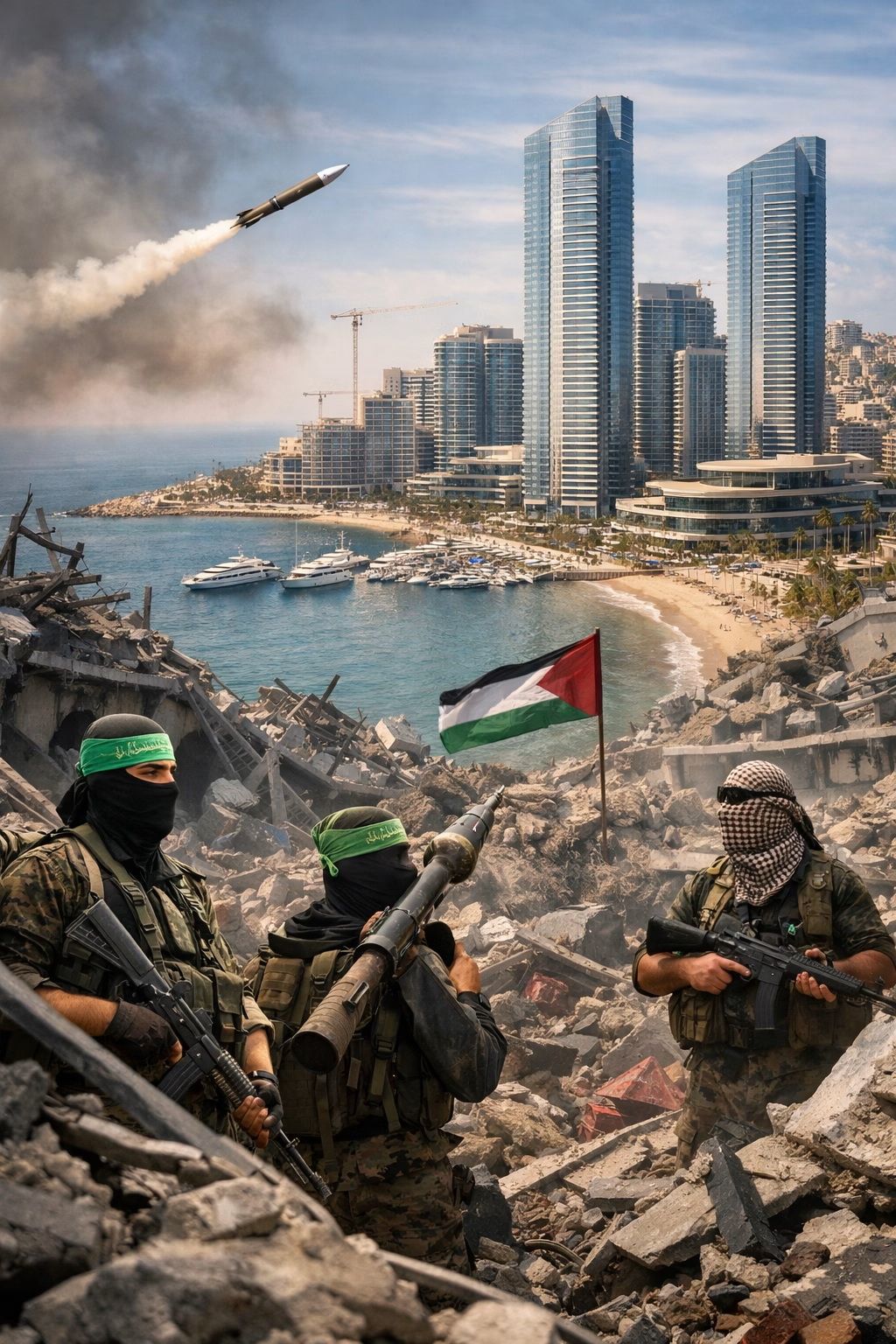
At Davos, Jared Kushner presented mock-ups of a gleaming “New Gaza”: waterfront towers, industrial parks, data centers, luxury apartments. Trump, ever the builder, remarked that Gaza is “a beautiful piece of property” with extraordinary potential.
The problem is not the vision. The problem is the reality:
you cannot erect skyscrapers over terror tunnels.
Even if Gaza were rebuilt, Hamas would retain:
- its underground military grid
- its Iranian supply channels
- its indoctrination curriculum
- its political stranglehold over civilians
High-rises do not neutralize ideology, and economic zones do not disarm militias. The Middle East is not a blank slate waiting for foreign investment. It is a battlefield where radical actors have repeatedly sabotaged prosperity to preserve their power.
The real “miscommunication” is Western naïveté
Special Envoy Steve Witkoff recently suggested that conflicts like Gaza and Syria stem from “miscommunication” and damaged “relationships.”
But Hamas is not miscommunicating.
It is articulating, loudly and consistently:
- rejection of any Jewish sovereignty
- glorification of violence
- indoctrination of children toward martyrdom
- enthusiasm for Iran’s regional ambitions
This is not a messaging gap.
It is a foundational worldview.
And Western diplomats who misdiagnose ideology as misunderstanding do not build peace — they prolong conflict.
Economic diplomacy works with states, not terror ecosystems
Economic leverage can influence rational governments. It cannot transform hybrid terror-state networks like Hamas or Iran’s regional axis.
Three immutable facts shape Gaza:
- Hamas views civilian suffering as strategic leverage, not a failure.
- Iran is prepared to sacrifice its own people for regional hegemony.
- Erdoğan’s Turkey pursues Islamist expansionism, not market-driven moderation.
In this environment, treating Gaza as a commercial redevelopment project is not strategy — it is self-deception.
Israel’s security comes before any international real-estate experiment
Israel is not opposed to improving Palestinian living conditions. In fact, Israel has repeatedly supported economic initiatives in Gaza, only to watch Hamas turn construction materials into rockets and humanitarian aid into military infrastructure.
The lesson is clear:
Peace cannot be built on an intact terrorist regime.
Before Gaza can thrive:
- Hamas must be dismantled
- Iranian arms flows must be stopped
- indoctrination networks must be dismantled
- the Palestinian Authority must cease glorifying violence
Without these prerequisites, no amount of capital will produce stability.
Hope is not a substitute for reality
Trump’s instinct to think big has yielded genuine achievements, such as the Abraham Accords — successes rooted in partnerships with pragmatic, stability-seeking states.
Gaza is not such a theater.
If the United States wishes to help build Gaza’s future, it must first help defeat the forces that destroy Gaza’s present. Otherwise, investment will remain nothing more than a façade over unresolved extremism.
Money can build towers, ports, and roads.
Only security can protect them.
And only the dismantling of Hamas can make any economic future remotely plausible.
Until that foundation exists, Israel cannot — and must not — wager its survival on the hope that ideologues can be bought.