
A recent image of a grieving Gazan girl comforting her mother at a funeral captures the tragedy of this conflict in one frame. For decades, Palestinians in Gaza have been caught between Hamas’s iron grip and Israel’s need for security. Both peoples have suffered deeply. But the real question today is: must the people of Gaza be condemned to repeat this endless cycle, or is there a future where they can finally live in peace and dignity—outside the battlefield Hamas insists on turning their home into?
Israel and the United States have been exploring one controversial but important option: facilitating the voluntary emigration of Gazans who wish to leave. Critics, from European chancelleries to human rights NGOs, are quick to cry “ethnic cleansing” or “forced transfer.” But these accusations ignore both the reality on the ground and the agency of the people themselves.
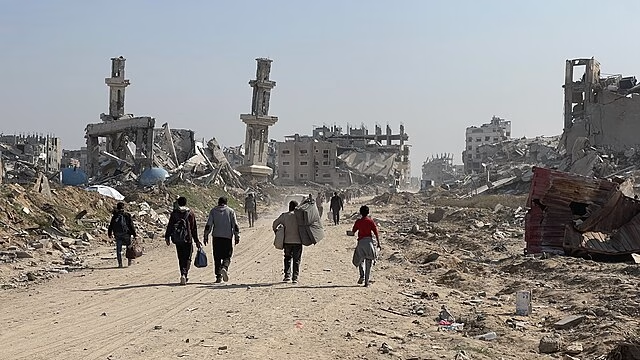
Let’s be honest: Gaza is not, and has never been, a paradise. Even before the current war, unemployment was above 40%, the economy was stagnant, and infrastructure crumbled under the weight of Hamas’s corruption and obsession with terror tunnels over schools and hospitals. After Hamas’s October 7th massacre in Israel—a crime so brutal it shocked the world—the situation for ordinary Gazans became even more unbearable. Millions were displaced within a war zone. Food, medicine, and housing remain scarce.
Against this backdrop, is it immoral to give Palestinians a way out? Or is it, in fact, the most humane option available?
A recent survey by the Palestinian Center for Policy and Survey Research found that 43% of Gazans said they would like to emigrate. Among young, educated Gazans, that number was as high as 75%. These are not statistics invented in Jerusalem or Washington. They come directly from Gaza. Many Gazans themselves are looking for the chance to start new lives abroad—away from Hamas, away from war, away from despair.
Israel’s critics insist that Gaza’s residents must remain trapped within the Strip at all costs. But why? Why should a mother raising children under constant bombardment or a young man seeking to study abroad be denied the opportunity to live in peace somewhere else? No one is suggesting forced deportation. What Israel and its allies are proposing is voluntary emigration with international support. The very word “voluntary” makes the difference between oppression and empowerment.
Yes, relocation raises difficult logistical and legal questions. Yes, no receiving country wants to bear the entire burden alone. But history is filled with examples of successful resettlement when the international community chooses to act. Jewish refugees after the Holocaust built flourishing lives in Israel, the U.S., and beyond. Vietnamese boat people rebuilt their lives across the West after the fall of Saigon. Millions of Syrians have found new homes across Europe and the Middle East after fleeing Assad’s regime. Why should Palestinians be uniquely barred from seeking similar opportunities?
Critics also claim such a plan would “drain” Gaza of its youth and professionals. But perhaps that is exactly what Hamas fears: losing its human shield. A Gaza where young people can leave, study, and work abroad is a Gaza where Hamas loses its monopoly on their lives and futures. That is not a loss to mourn—it is liberation.
The heartbreaking funeral scenes in Gaza remind us of the human cost of this war. But if the world is truly committed to Palestinian dignity, then it must be willing to think beyond slogans and rigid formulas. If nearly half the people in Gaza want to leave, it is not Israel’s duty to trap them in misery for the sake of political narratives. It is Israel’s duty—and the duty of the international community—to help them live.
Voluntary relocation is not ethnic cleansing. It is not expulsion. It is, quite simply, giving Gazans who want to leave a choice: to build a future free of Hamas’s death cult, free of war, free of endless funerals.
For too long, Gaza has been a prison—guarded not by Israel, but by Hamas. It’s time to open the gates.