
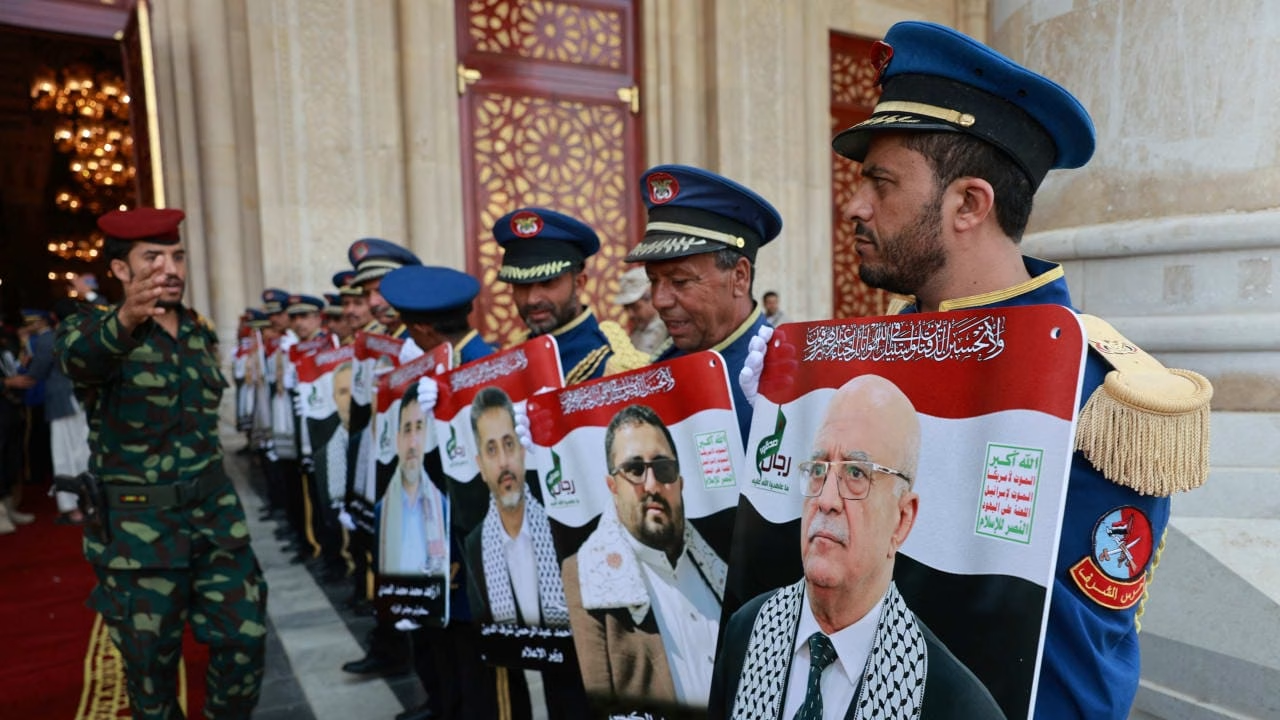
Israel’s precision operation that eliminated senior Houthi officials underscores a hard-edged strategy: act early, act far, and make those who threaten Israeli civilians and global shipping pay an immediate price.
In the span of a few hours, Israeli intelligence detected an imminent gathering of Houthi government ministers in San’a—and the Israeli Air Force turned that fleeting signal into decisive action. A targeted strike on the conference hall where the officials assembled killed key figures, including the Houthis’ prime minister and foreign minister, according to Houthi statements. The message was unmistakable: the Iranian-backed militia that has menaced Red Sea commerce and fired at Israel is no longer operating beyond the reach of Israeli power.
This was not the slow, telegraphed playbook that Middle East adversaries have learned to exploit. It was rapid detection, rapid decision, and rapid delivery—an approach that has taken shape since the Gaza war as Israel expanded its focus to the broader Iranian axis. For years, the Houthis were a relative blind spot for Israel. No longer. Israeli military intelligence has built a dedicated capability to map Houthi operations, leadership patterns, and communications discipline. The result is what soldiers often summarize with a blunt aphorism: provoke Israel, and you’ll meet consequences—swiftly.
Critics will argue that the strike hit the “administrative façade” rather than the militia’s entrenched power structure. That view understates how organizations actually function. Leadership cohesion is not cosmetic; it’s operational glue. When senior officials are eliminated in a single blow, cadres scatter, schedules change, and paranoia becomes policy. Even if replacement figures step forward, they do so in the shadow of vulnerability—less confident, more constrained, and far more preoccupied with survival than with plotting the next attack on Israel or a merchant ship.
The Houthis have tried to project defiance. They continue to launch drones and ballistic missiles toward Israel and to threaten international shipping. In recent weeks, Israeli officials reported the first Houthi missile armed with cluster munitions aimed at Israel—an escalation in both lethality and recklessness. Yet Israeli defenses have kept those salvos from reaching the country, and the Yemen strike demonstrates that interception isn’t Israel’s only answer. Deterrence requires not just shields but swords—and swords that don’t wait for the next barrage to land.
Context matters here. The entity targeted is designated a terrorist organization by the United States and does not represent Yemen’s internationally recognized government in Aden. The broader Yemeni population—already suffering from poverty and years of war—deserves protection from a militia that hijacks state institutions while exporting violence across borders. Precision strikes on leadership nodes, taken to preempt attacks and to defend Israeli lives and global commerce, fit squarely within the inherent right of self-defense against an armed group openly waging hostilities.
Nor is this merely an Israeli-Houthi duel. Tehran’s strategy relies on proxy groups—from Gaza to Lebanon to Yemen—to stretch Israel thin and to erode international resolve by turning the Red Sea into a chokepoint of fear. By demonstrating it can generate credible, time-sensitive targeting against Houthi leadership deep in Yemen, Israel signals to every spoke in Iran’s wheel that geography will not guarantee impunity. The practical effect is to raise the cost of aggression not just after attacks, but before the next “go” order is ever given.
There are, of course, limits. Israel has neither the appetite nor the need for a long war in Yemen. Sustained maritime security and a stable deterrent against Houthi adventurism will require coordinated pressure by the United States and willing partners—diplomatic, economic, cyber, and if necessary, kinetic. But coalition action is most effective when led by states that show they will not be coerced. Israel’s operation does precisely that: it shows initiative, precision, and an understanding that in this theater, timidity invites more risk, not less.
Some will still ask whether decapitating part of a hostile administration truly changes Houthi behavior. The answer is that it already has—because behavior is shaped as much by the fear of exposure as by ideology. When leaders abandon predictable routines, when they shun phones, when they move beds nightly and cancel meetings at the last minute, their operational tempo suffers. Every added layer of operational security is a layer of friction that saves Israeli lives and keeps shipping lanes safer.
The Houthis can continue to bluster. They can promise revenge and posture as the vanguard of “resistance.” But the realities now confronting them are stark: Israeli intelligence is watching, Israeli reach is real, and Israeli patience for serial aggression has run out. Those who choose to launch missiles at civilians and to hold global trade hostage should not expect cost-free nights of committee speeches in the capital. They should expect consequences—calibrated, precise, and, when necessary, immediate.
Israel’s strike in San’a doesn’t end the Houthi threat. It does, however, reset the rules. It tells every actor in the region that Israel will not fight on terms set by its enemies, nor wait passively for the next attack. In an environment where deterrence is tested daily, restoring credibility is not a slogan; it’s a strategy. And on that night, in that hall, credibility was restored.