
The heartbreaking mission to recover the bodies of Israeli hostages from Gaza is not just a humanitarian operation. It is a moral imperative — a solemn promise from a nation that refuses to leave its sons and daughters behind, even in death.
In recent days, Israel and several mediating countries have formed an international task force — including Egypt and Turkey — to locate the remains of hostages still buried in Gaza’s ruins. Hamas has so far returned only a fraction of the bodies, claiming that many cannot be found. But as with so much involving Hamas, the truth is layered beneath years of deception, chaos, and cruelty.
Israel’s challenge is immense. Gaza today lies in ruins after Hamas turned neighborhoods into fortresses and command centers, embedding rocket launchers and tunnels beneath homes, schools, and hospitals. According to satellite analyses, more than 60% of Gaza’s buildings have been damaged or destroyed since the October 7 massacre that ignited this war. Finding any body — Israeli or Palestinian — under such destruction is excruciatingly difficult.
But the difficulty isn’t only physical. It’s moral. Hamas’s systematic use of civilians and hostages as human shields has created a fog of horror that still obscures the truth. Even in death, Hamas weaponizes the remains of the innocent — treating the bodies of murdered hostages as bargaining chips rather than sacred lives deserving dignity and rest.
Israel, by contrast, continues to uphold a national ethos that values every life — and every memory. From its founding, the State of Israel has committed to bringing its people home, whether alive or fallen. This is why Israeli soldiers salute as convoys arrive at Tel Aviv’s Abu Kabir Forensic Institute. It is why families who have endured unimaginable loss still demand the return of their loved ones. And it is why Israel will not rest until every hostage is accounted for.
The Israeli government and IDF have already carried out painstaking operations — some successful, others not — to recover bodies from tunnels and collapsed structures. Soldiers have drilled into underground shafts, sifted through debris, and risked their own lives to honor those who can no longer speak for themselves. Intelligence officers, interrogating captured Hamas fighters, have pieced together scraps of information that sometimes lead to discovery — and sometimes only to heartbreak.
Critics will argue that Israel should focus solely on rebuilding or on cease-fire negotiations. But for the families of the hostages, closure is not a political luxury. It is a basic human need. A society that honors its dead — that refuses to let their memories be erased by terror — is a society that refuses to be broken.
Some mediators acknowledge that Hamas may not even know where all the bodies are. The chaos of war, the collapse of tunnels, and the group’s own internal disarray make that plausible. But Israel also knows that Hamas values leverage more than truth. The hostages’ bodies are tools of pressure — a cruel currency traded for international sympathy or concessions.
That is why Israel’s commitment to recover them transcends politics. It is not about optics. It is about identity. The Jewish tradition teaches Kol Yisrael arevim zeh bazeh — “All Israel is responsible for one another.” This responsibility doesn’t end with life; it continues into death.
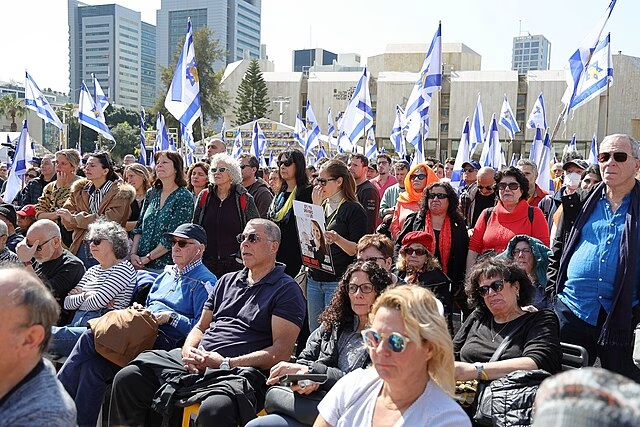
The Hostages Families Forum recently declared, “The agreement cannot continue to be implemented without Hamas returning all the hostages.” Their words reflect a national truth: until every hostage, living or deceased, is home, Israel’s heart remains divided.
The rubble of Gaza hides many secrets — some buried by bombs, others by lies. But beneath it all lies something indestructible: the determination of a people who will never stop searching, never stop remembering, and never stop bringing their own home.